
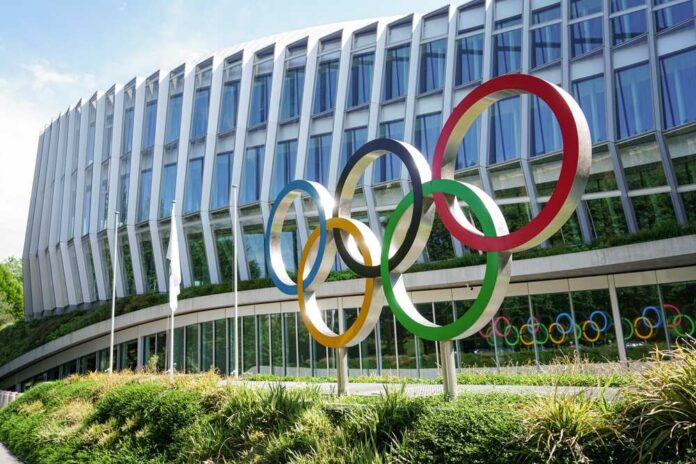
The IOC’s new “biology-only” rule for women’s Olympic events is igniting a familiar fight: whether protecting women’s competition now requires the kind of intrusive verification Americans thought sports had left behind.
Story Snapshot
- The International Olympic Committee announced an “evidence-based” policy limiting women’s Olympic categories to biological females, verified by a one-time SRY gene screen using saliva, cheek swab, or blood.
- Former U.S. soccer star Megan Rapinoe blasted the policy on her podcast, calling it hateful, invasive, and politically motivated—specifically alleging it caters to the Trump administration.
- World Athletics officials have pointed to past over-representation of athletes with male biological advantages in female finals as justification for tighter eligibility rules.
- Olympic gold medalist Kaillie Humphries praised the policy as a win for fairness in women’s sports ahead of the LA28 Games.
What the IOC changed—and how the screening works
The IOC’s updated eligibility policy restricts women’s Olympic events to biological females and uses a one-time test that checks for the SRY gene, a genetic marker associated with male sex determination. Testing may be done by saliva sample, cheek swab, or blood. The IOC has described the shift as evidence-based and aimed at protecting the integrity of female categories as the Olympics approach Los Angeles in 2028.
The practical effect is straightforward: athletes who do not meet the biological eligibility standard would be excluded from women’s categories, with significant implications for transgender athletes and some athletes with differences of sex development (DSD). Supporters argue the rule restores a clear boundary that protects women’s opportunities. Critics argue the rule revives sex verification in a modern form, raising concerns about privacy, dignity, and potential misuse even if the test is performed only once.
Rapinoe’s critique spotlights a deeper political divide
Megan Rapinoe attacked the IOC policy publicly on her “A Touch More” podcast, calling it a “really horrible rule,” “not science-based,” and “invasive.” She also framed it as political, alleging it represents “total acquiescence” to the Trump administration and claiming the motivation is animus toward transgender people. Those claims reflect her broader public profile as an equality advocate, but the reporting does not provide independent confirmation that the White House directed the IOC decision.
The politics matter because the IOC rule lands in a moment when many conservative voters are tired of institutions that once embraced progressive social priorities—and equally tired of heavy-handed enforcement that disregards ordinary people. For Trump-aligned Americans, the tension is real: many want clear, common-sense women’s categories, yet many also distrust elite bodies that impose intrusive rules from above. The question becomes whether the IOC can protect fairness without creating a new bureaucratic machine that tramples individual rights.
What the “science-based” argument relies on
The most concrete evidence cited in coverage comes from World Athletics. A panel in Tokyo led by Dr. Stéphane Bermon highlighted that dozens of athletes with male biological advantages have appeared as finalists in female categories since 2000, with DSD over-representation raised as a key concern. That framing underpins the competitive-fairness argument: if women’s sport is defined to provide a level playing field for female athletes, then eligibility standards must address physiological advantages linked to male development.
The sources describe the SRY screen and sample methods, but they do not fully explain how the IOC will handle edge cases, appeals, medical privacy protections, or how data will be stored and safeguarded. That lack of detail is not a minor issue: once sports governance starts collecting biological data, the temptation for mission creep—more testing, more categories, more enforcement—always exists.
Why LA28 timing and athlete reactions are raising the stakes
The policy’s debut ahead of the 2028 Los Angeles Olympics puts U.S. politics in the background whether the IOC wants it there or not. Rapinoe explicitly tied the move to Trump-era pressure, while supporters see a course correction after years of contested transgender eligibility standards. The IOC’s earlier approach evolved from permissive rules in the 2000s to testosterone-based limits in the 2010s, before moving now toward a biology-defined line.
Kaillie Humphries, a three-time Olympic gold medalist, publicly celebrated the IOC’s decision as a “great day for women’s sports,” and pointed out that sex testing “used to happen years ago.” That comment captures the uncomfortable tradeoff: stricter rules may reassure female athletes about fairness, but they also normalize a return to verification. For conservatives who prioritize both protecting women’s sports and limiting institutional intrusion, the next chapter will hinge on transparency, due process, and whether the IOC can avoid punishing innocent athletes caught in bureaucratic crossfire.
Sources:
Megan Rapinoe rips IOC’s new policy to protect women’s sports, rejects notion rule based in science
Megan Rapinoe: Equality & Equal Pay