At the United Nations, Israel’s leader praised President Trump as his “greatest partner” in war, putting U.S. politics squarely into a global fight.
Story Snapshot
- Prime Minister Benjamin Netanyahu lauded President Trump at the United Nations and framed Israel’s fight as a multi-front war.
- Netanyahu linked Trump’s support to confronting Iran and other threats, underscoring tight U.S.-Israel coordination.
- Delegates and protesters reacted sharply, highlighting deep global divides over the Gaza war and Iran.
- The moment fits Netanyahu’s long pattern of using the UN stage to send political signals at home and abroad.
Netanyahu’s UN Praise for Trump and Wartime Framing
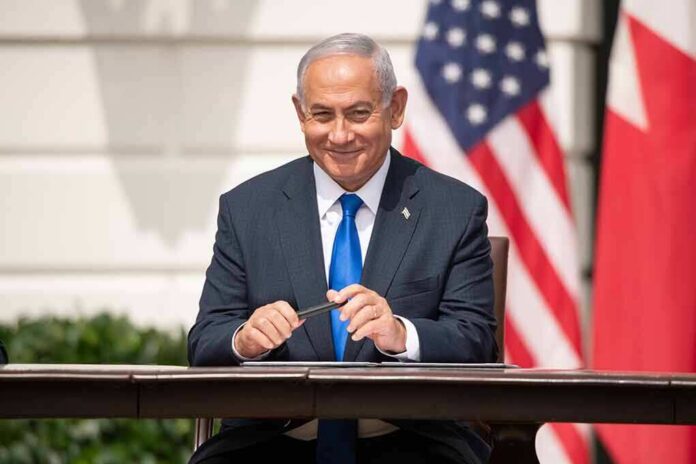
On September 24 in New York, Israeli Prime Minister Benjamin Netanyahu addressed the United Nations General Assembly. He said Israel has “had no greater partner than President Trump” in its current fight. He thanked Trump and cast the conflict as a “battle” against “barbarians,” echoing his past civilizational tone. He described a “seven-front war” and tied his remarks to recent casualties and attacks. The speech set a clear message: Israel sees the struggle as broad and long-term, with the United States at its side.
Netanyahu also connected the praise to concrete action against Iran. Reports on the address quoted him crediting Trump’s “bold leadership” and support in countering what he called a shared danger. He said attacking Iran was among his easiest decisions, underscoring the stakes and the pace of military choices. The remarks framed Iran as a central node in the threat network Israel faces, with American backing described as vital to deter and respond to attacks.
Why This Lands Hard in U.S. Politics
The statement arrived as President Trump leads a Republican government in Washington. The comment at a global forum places U.S. domestic divides inside an international war narrative. Conservatives see validation for America First defense ties and pressure on Iran. Liberals see concern about expanding conflict, fossil-fuel politics, and the human cost in Gaza. Both sides share a worry that leaders serve their own survival more than the public, and that elites steer policy without clear accountability.
Many Americans also view the United Nations with mixed trust. Some believe it enables endless talk while crises grow. Others see it as a needed check on power. Netanyahu’s move harnessed that tension. He appealed to allies who want firm lines and swift action. He also dared critics who accuse Israel of going too far. By praising Trump in that setting, he bound Israel’s course to the current White House, which may please hawks but risks backlash if policies fail or the war widens.
Global Reaction and Pattern at the UN
Delegations and activists outside the hall signaled deep anger over Gaza and Israel’s tactics. Reports described walkouts by diplomats during Netanyahu’s appearance, a visible sign of protest. Coverage also showed continuing demonstrations near the United Nations, reflecting global frustration and fear of a broader regional war. These reactions mirror recent years, where leaders trade sharp words in the chamber while streets fill with people calling for restraint or change.
Analysts have noted that Netanyahu often uses the United Nations to speak past the room and toward multiple audiences. He mixes domestic aims with international goals. He frames the fight against Hamas and Iran as part of a larger battle over values, truth, and survival. That approach usually draws clear lines and loud responses. Some nations applaud the moral clarity. Others reject the framing as one-sided or dangerous. The result is a predictable split, but also a clear message of resolve to his base.
What It Means for Americans Watching at Home
For many families in the United States, key questions loom. Will a tighter bond with Israel pull America deeper into conflict with Iran? Will the war drive energy prices and inflation higher again? Will Washington explain the costs and limits of its support, or hide them in jargon and briefings? Voters on the right and left are tired of speeches that do not fix real problems. They want honest goals, measured plans, and someone to own the results.
Netanyahu’s praise of Trump is not just a headline. It is a signal of intent in a dangerous season. It ties two governments together at a time when mistakes can spread fast and far. It also highlights a larger truth that many Americans already feel: global power struggles keep landing on their doorstep, while leaders in suits argue in distant halls. The stakes are real. The bill, whether in dollars or lives, will not be paid by elites alone.
Sources:
abc7ny.com, un-forum.org, euobserver.com, dw.com