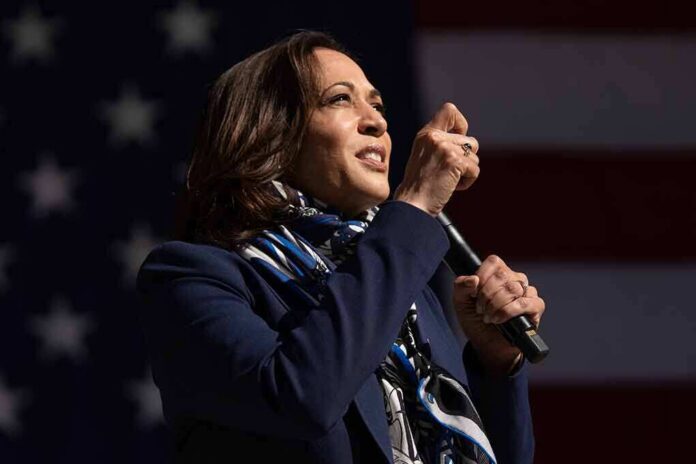
Kamala Harris urged Congress to slow frontier artificial intelligence and create a new federal watchdog, reviving a high-stakes fight over who controls powerful tech.
Story Highlights
- Harris warned that frontier artificial intelligence is advancing too fast and needs guardrails.
- She called on Congress to set up a federal body to test and oversee advanced systems.
- She pressed for an international agreement, including with China, to curb risky uses and set standards.
- Her stance echoes earlier actions requiring federal agencies to prove their artificial intelligence tools are safe.
Harris Calls for Slower Frontier AI and New Federal Oversight
On September 14, Kamala Harris warned that frontier artificial intelligence is advancing at an “alarming speed” and said the country needs “sensible guardrails” so the technology does not escape human control. She urged Congress to create a new federal entity to independently test and oversee advanced systems, placing government back in the driver’s seat of safety checks. The ask targets models with fast-growing capabilities, where small mistakes can scale into wide harm.
Harris tied the slowdown to specific oversight tools. She focused on pre-deployment testing, safety evaluations, and clear rules for risky uses. She framed the goal as preventing failures before they spread. Critics often call this a brake on progress. Supporters view it as a standard for high-risk tech, like aviation or drugs. The core policy idea is simple: if a system can cause big harm, an independent check should confirm safety before the public pays the price.
Push for Global Rules and Coordination With Rivals
Harris also pressed for an international agreement that includes China to limit dangerous uses, set common testing standards, and manage development speed. She argued that cross-border rules matter because models, code, and misuse can move fast across the internet. That view aligns with a broader push for safety cases, registration, and clear standards in frontier artificial intelligence governance seen in policy work at home and abroad. Shared norms can reduce gaps that bad actors might exploit.
Her call follows past work to set rules beyond U.S. borders. In late 2023, she backed a Political Declaration on Responsible Military Use of Artificial Intelligence and Autonomy, which promotes safeguards, testing, and legal review for defense applications. Months earlier in London, she urged partners to apply and build international norms for artificial intelligence uses across sectors. Those steps show a pattern: treat the technology as a global system and seek common brakes where risks are large.
Link to Earlier Federal Safeguards and Today’s Policy Gap
Harris’s new warning builds on a 2024 action that required federal agencies to verify artificial intelligence tools did not put Americans’ rights or safety at risk. Agencies that could not add safeguards had to pause use unless they made a strong case to continue. That order set a bar inside government. The latest push aims to extend that bar to private frontier models through independent testing and clear standards before broad deployment.
Published reporting does not show a new law, order, or signed deal yet tied to this week’s call. The request signals a policy direction and a concrete oversight design, but Congress and the executive branch would still need to draft, fund, and staff a new entity to make it real. That execution step is where fights often begin in Washington, especially when speed, innovation, and national security all compete for first place.
Why This Matters Across the Political Spectrum
Both parties say government often fails to act before crises hit. Artificial intelligence raises that fear because errors can scale fast. Harris’s plan centers on third-party tests, rules for risky uses, and shared global standards. Those moves seek to keep power over the tools with people, not with black-box systems or a few companies. Many conservatives worry about foreign threats and job loss. Many liberals worry about inequality and bias. Careful oversight speaks to both concerns.
The politics are hard. President Trump and a Republican Congress set the agenda, and industry leaders want to stay competitive. Slowing parts of frontier development could clash with growth goals. Still, a basic safety check before release is familiar policy in other fields. The open question is not whether to care about risks, but who writes the rules, who runs the tests, and how fast enforcement can keep up with new, more capable systems.
Sources:
redstate.com, foxnews.com, apnews.com, x.com, bloomberg.com, wired.com