Americans are getting a front-row lesson in what happens when Washington politics come before paying the people who protect our airports.
Quick Take
- DHS confirms 376 TSA officer resignations since paychecks stopped on Feb. 16 during a month-long funding lapse.
- Staffing losses are concentrated at major hubs like Houston (IAH), Atlanta (ATL), and New Orleans (MSY), triggering checkpoint disruptions and volatile wait times.
- A TSA union local says 2,100 additional agents have filed transfer paperwork, suggesting deeper workforce instability than resignations alone show.
- Airlines have revived no-fee same-day flight change policies to manage disruption, while Global Entry enrollment centers face closures and cancellations.
Funding Lapse Leaves Front-Line Screeners Unpaid
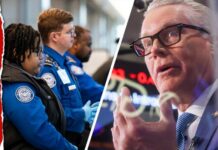
The Department of Homeland Security funding lapse that began Feb. 14 has now stretched roughly a month, and TSA officers have been working without regular pay since Feb. 16. DHS later confirmed 376 TSA officer resignations during the pay lapse. TSA’s national screener workforce is about 54,000, meaning the raw percentage looks small on paper, but the practical impact shows up where losses cluster at specific airports and shifts.
Travelers are seeing the consequences in real time. Reports describe long lines, sudden checkpoint closures at some facilities, and day-to-day unpredictability that makes planning almost impossible for families and business travelers alike. When security screening becomes erratic, it doesn’t just frustrate passengers; it strains airport operations, disrupts airline schedules, and raises basic questions about how long critical infrastructure can be run on morale and goodwill alone.
Localized Attrition Creates Outsized Chaos at Major Hubs
DHS data shows the staffing hit is not evenly spread. Houston’s Intercontinental Airport (IAH) reportedly lost 66 officers, Atlanta (ATL) lost 54, and New Orleans (MSY) lost 31. In some locations, absentee rates exceeded 30%, forcing temporary checkpoint closures. Atlanta’s wait times were described as swinging wildly—two-hour lines, then five minutes, then back to 90 minutes—sometimes within the same day.
CBS reporting also pointed to another warning sign: sick calls increasing sharply, with the number of agents calling out more than doubling during the shutdown period. That pattern matters because resignations are only one way staffing collapses. Even before an employee quits, a workforce that is stressed, unpaid, and uncertain can become unreliable through absenteeism, overtime refusals, and delayed training—each of which compounds pressure on the remaining officers.
Union Warns Resignations Understate the Real Workforce Drain
The American Federation of Government Employees local representing TSA workers says the resignation count doesn’t capture the full scope of the staffing threat. According to that union local, 2,100 additional agents have filed transfer paperwork to other federal agencies or local police departments. Transfer filings are not the same as completed departures, and the final number is unclear, but the volume signals that many officers are actively planning an exit.
This distinction matters for travelers trying to understand what comes next. A resignation figure describes what already happened; a large transfer pipeline describes what could still happen even after funding is restored. If Congress resolves funding but the workforce concludes the job is politically disposable, TSA could face a lingering retention problem. DHS has warned absenteeism could double by the end of the month, which would collide with heavy seasonal travel.
Airlines and Trusted Traveler Programs Feel the Ripple Effects
Airlines are already adjusting to keep passengers moving. United and Delta reportedly reopened pandemic-era same-day flight swap policies with no fee, essentially admitting that screening delays and missed connections are becoming routine. Airlines for America leadership has publicly urged lawmakers to restore funding and pay TSA officers, framing the situation as an avoidable breakdown that punishes the traveling public for political stalemate.
Beyond standard screening, Trusted Traveler services are being disrupted. Global Entry enrollment centers in Denver and Miami were reported closed, and interview appointments may be canceled without notice. For many frequent flyers, Global Entry is a practical tool to reduce wait times and restore predictability. When these programs stall, the backlog grows—and families and older travelers often end up absorbing the costs through longer lines, missed flights, and rebooked plans.
Political Stalemate Collides With Public Expectations of Basic Governance
Congressional finger-pointing won’t get passengers through security any faster. A House Homeland Security hearing is scheduled to examine TSA morale, but reporting indicated there is “no legislative vehicle attached,” meaning the hearing itself does not solve pay or funding. President Donald Trump has publicly thanked TSA agents and blamed Democrats for the shutdown in a Truth Social post, while broader reporting describes an impasse tied to immigration policy demands.
TRAVEL NIGHTMARE: Over 400 TSA Officers QUIT, $2.5 BILLION LOST — Airports in CHAOS as Americans Pay the Price for Democrats’ Political Games
Jim Hᴏft Mar. 22, 2026https://t.co/bwS8rBODRD— Eduardo Barranco (@Eduardo19832958) March 23, 2026
Some online headlines claim “over 400” resignations and cite large dollar-loss figures, but the provided source material does not substantiate a $2.5 billion loss number, and the confirmed resignation total in DHS reporting is 376. The concrete, verifiable takeaway is still alarming: when government funding lapses, the public sees immediate damage in transportation security, travel reliability, and basic confidence that Washington can keep essential systems running.
Sources:
Hundreds of Unpaid TSA Officers Resign, Exacerbating U.S. Airport Delays