

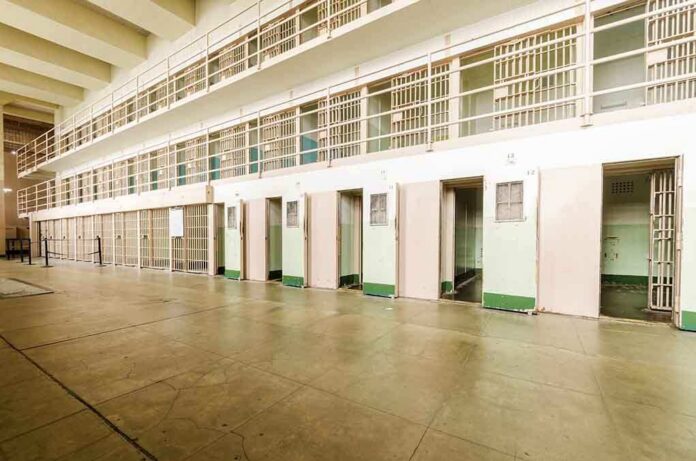
New York City’s new mayor just pushed back a legally required jail closure by five years, betting that fewer new jail beds and more treatment programs can replace one of the country’s most notorious lockups.
Story Snapshot
- Mayor Zohran Mamdani released the city’s first full plan to close Rikers Island, targeting December 31, 2032.
- That date misses the 2027 deadline New York City Council set back in 2019 by five years.
- Four borough jails will open in stages: Brooklyn in 2029, then Queens and the Bronx in 2031, then Manhattan in 2032.
- The city will spend $146 million on mental health care, job training, and victim services, plus $76 million more for community programs.
- Critics warn the new jails will hold far fewer people than Rikers does now, raising questions about what happens if the population doesn’t shrink fast enough.
A Long-Promised Closure Gets a New Deadline
Mayor Mamdani announced the “Close Rikers: Strategic Plan” as the city’s first detailed roadmap for shutting down the jail complex entirely. Under the plan, incarceration at the current Rikers facilities ends by the close of 2032. That timeline falls five years past the 2027 deadline lawmakers approved in 2019, a gap multiple outlets have flagged as a major sticking point.
The four replacement jails will open on a staggered schedule. Brooklyn’s facility comes first in 2029, followed by Queens and the Bronx in 2031, with Manhattan last in 2032. City officials say these smaller, borough-based sites sit closer to courts, public transit, and families than the isolated island facility, which has been plagued for years by violence and understaffing.
Money for Treatment, Not Just Construction
Beyond bricks and mortar, the plan commits $146 million to mental health care, substance-use treatment, education, job training, and victim services, with another $76 million aimed at community-based programs. The city also plans hundreds of therapeutic beds for people with serious psychiatric or medical needs, an attempt to treat some detainees outside a traditional jail setting. Whether those investments actually keep people out of jail cells, rather than simply adding services around the existing system, remains unproven.
The entire strategy rests on one core bet: shrinking the number of people held before trial. City officials say reducing pretrial detention and speeding up slow court cases are just as central to the plan as building new buildings. If that population doesn’t drop enough, the math behind the plan starts to look shaky.
Capacity Math Draws Sharp Criticism
That’s exactly where critics are aiming. The four new jails will hold about 4,160 people combined, roughly a third of what the current system can hold, according to reporting on the city’s own figures. One commentary outlet argues the administration is leaning on four uncertain tools, including pretrial diversion, easier bail access, faster case processing, and recidivism-reduction programs, to close that gap. The same piece warns that if the population outpaces capacity, the result could be dangerous overcrowding or the release of people accused of serious violent crimes.
That capacity argument cuts to a concern shared across the political spectrum: can city government actually deliver what it promises, or will residents be left managing the fallout? Supporters counter that Rikers’ 15,000-bed capacity reflects decades of over-incarceration, not a baseline the city must match. But the plan’s own documents don’t yet include a published population forecast showing the smaller system will hold up, which leaves a real gap between promise and proof.
pay attention:
**Not a Mamdani fan BUT…
This comes from legislation the New York City Council passed in 2019 (under then-Mayor Bill de Blasio). The original target was December 31, 2026; it was later extended to August 31, 2027 because of COVID-related construction delays.…
— flappospammo (@flappo_spammo) November 21, 2026
Neighborhood Opposition Adds Another Layer
Local resistance has already slowed one piece of the plan. Chinatown residents sued to block construction of the Manhattan jail at the White Street site, arguing that nearly round-the-clock construction noise for six years amounts to cruel and inhumane treatment of their neighborhood. Other critics in the same community say the site should become affordable housing instead of a jail. These fights echo a pattern stretching back decades. A 1979 city report also recommended closing Rikers, but cost concerns and political opposition sank it, and many of the same arguments about danger, isolation, and uncertain replacements have resurfaced in 2026.
The city’s 2019 closure plan ran into similar construction delays, local pushback, and a rebounding jail population, which is why the original 2027 deadline slipped in the first place. Whether this new 2032 target holds, or becomes another missed promise, depends on variables the plan has not yet fully documented, including financing, population forecasts, and legal compliance with the original court-ordered timeline.
Sources:
thegatewaypundit.com, nyc.gov, gothamist.com, apnews.com, courthousenews.com, unitednewslive.com, 6sqft.com, nbcdfw.com, blavity.com