
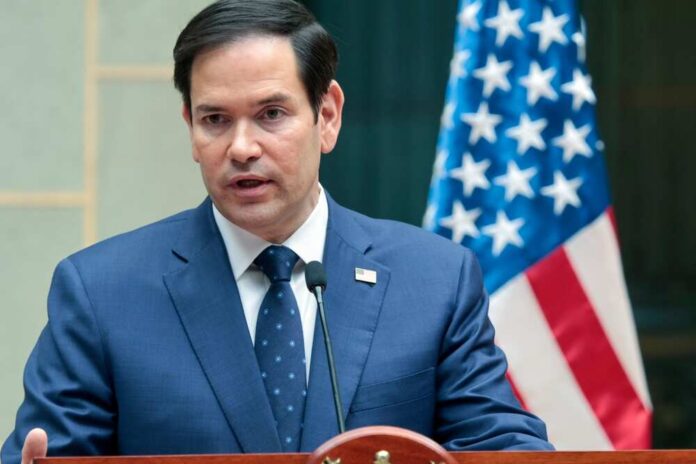
The Trump administration just moved to remove U.S. residency protections from relatives tied to one of the most infamous propaganda figures of the 1979 Iran hostage crisis—reviving a debate over how America vets who gets to stay.
Quick Take
- Secretary of State Marco Rubio terminated the lawful permanent resident status of Seyed Eissa Hashemi, his wife Maryam Tahmasebi, and their son, placing them in ICE custody pending removal.
- The family is linked to Masoumeh Ebtekar, known to many Americans as “Screaming Mary,” who served as a spokesperson for the Iranian militants who held 52 Americans hostage for 444 days.
- Reports say the family entered the U.S. in 2014 and later obtained green-card status in 2016 through the Diversity Immigrant Visa Program during the Obama administration.
- The case fits a broader pattern of Trump-era scrutiny aimed at relatives of senior Iranian regime figures as U.S.-Iran tensions remain high.
Rubio’s revocation order puts the family on a deportation track
Secretary of State Marco Rubio terminated the lawful permanent resident status of Seyed Eissa Hashemi, his wife Maryam Tahmasebi, and their son, and the family is now reported to be in ICE custody pending removal proceedings. The action was tied to their family relationship to Masoumeh Ebtekar, a well-known Iranian regime figure whose role during the 1979 hostage crisis remains a political flashpoint in the United States decades later.
Public reporting says the family first received visas in 2014 and later obtained lawful permanent resident status in June 2016 via the Diversity Immigrant Visa Program. That timeline matters because it places their entry and status adjustment during an era when critics argued U.S. immigration screening was too permissive about applicants from hostile or high-risk environments. The State Department’s move effectively reverses the protections that come with a green card, shifting the case into removal territory.
Why “Screaming Mary” still resonates in American politics
Masoumeh Ebtekar, widely nicknamed “Screaming Mary” in U.S. media coverage at the time, served as a prominent spokesperson for the militants who seized the U.S. Embassy in Tehran on November 4, 1979. Fifty-two American hostages were held for 444 days, and staged media appearances meant to portray humane treatment even as accounts circulated of harsh conditions. Ebtekar later remained a significant figure inside Iran’s government.
The Rubio decision draws its moral force from that history: many Americans still see the hostage crisis as a defining moment of anti-American aggression that helped shape modern U.S.-Iran distrust. For conservative readers, this kind of case is often less about “guilt by association” and more about whether U.S. policy should tolerate residency for families tied to propaganda and power networks linked to regimes hostile to American citizens.
The Diversity Visa angle reignites a long-running vetting argument
Reports say the family’s lawful permanent resident status came through the Diversity Immigrant Visa Program, a lottery-style pathway that has long divided Washington. Supporters argue it broadens opportunity, while critics argue it can be exploited when identity, background, or overseas connections are difficult to verify. In this case, the political controversy is sharpened by the family’s connection to a high-profile regime insider, a factor that critics argue should have triggered closer scrutiny before any status upgrade.
At the same time, the public record in the provided research is thin on specific vetting failures—what was checked, what was missed, and which agency knew what at the time. This underscores a shared frustration across the right and left: average citizens face intense rules and consequences, while decisions made by distant federal systems can appear inconsistent, opaque, or driven by politics.
A broader enforcement pattern emerges as U.S.-Iran tensions persist
The Hashemi case is not described as a one-off with other recent actions targeting relatives of prominent Iranian figures, including people linked to former Iranian security leadership and relatives of Qasem Soleimani. Those removals, combined with Rubio’s public posture on Iran as a leading hostage-taking and terrorism sponsor, indicate the administration is treating family-network ties as a national security concern rather than merely an immigration paperwork issue.
Secretary Marco Rubio TERMINATES Legal Status of Family Members Linked to Infamous 1979 Iranian Hostage-Taker Propagandist ‘Screaming Mary’ https://t.co/RIPWjJRjoG #gatewaypundit via @gatewaypundit
— tim fucile (@TimFucile) April 12, 2026
Politically, the move plays into a 2026 landscape where Republicans control Congress and Democrats are positioned mostly as opponents rather than governing partners. Conservatives who felt burned by years of globalist assumptions and lax enforcement will likely view this as a long-delayed correction. Liberals wary of expansive executive power will likely question process and precedent. Either way, the case highlights a core question: whether U.S. residency is treated as a privilege tied to national interest—or as a status the government struggles to revoke even in high-profile, high-tension scenarios.
Sources:
iranian-nationals-arrested-rubio-revokes