A reality TV star who lost his home to wildfire is now leading the charge against Los Angeles establishment politicians, promising to end the billion-dollar homeless industry grift that has turned America’s second-largest city into an open-air drug market.
Story Snapshot
- Spencer Pratt surges to second place in LA mayoral race, attacking incumbent Karen Bass over 40% recidivism rate in $300M homeless program
- Former reality star vows zero encampments, mandatory treatment for addicts, and IRS audits of nonprofit organizations receiving over $1 billion annually
- Debate exposes deep frustration with establishment politicians as cost of living soars and fentanyl deaths increase 1,000%
- Palisades Fire victim accuses Bass of criminal negligence after 6,800 structures destroyed and emergency water reservoirs found empty
Outsider Candidate Taps Into Rising Anger
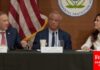
Spencer Pratt, former star of MTV’s The Hills, has emerged as a serious contender in Los Angeles’s mayoral race by channeling widespread frustration over the city’s spiraling homelessness crisis and skyrocketing cost of living. During a recent debate with incumbent Mayor Karen Bass and City Councilwoman Nithya Raman, Pratt distinguished himself by directly confronting what he calls the “grift” of nonprofit organizations that consume over $1 billion annually while street conditions worsen. His personal stake in the race intensified after losing his Pacific Palisades home in the January 2026 fire that destroyed 6,800 structures and killed 12 people.
Pratt’s campaign promises represent a stark departure from current policy. He has pledged to achieve zero homeless encampments through mandatory treatment programs rather than the voluntary approaches favored by Bass. His vow to bring in federal IRS agents during his first week in office to audit every dollar spent on homelessness programs resonates with voters exhausted by visible disorder and billions spent with minimal results. Polls show Pratt running second behind Bass, a remarkable achievement for a candidate with no traditional political background who is largely campaigning through social media.
Inside Safe Program Draws Scrutiny
Mayor Karen Bass has defended her Inside Safe program, which she touts as the only citywide initiative to reduce street homelessness, claiming a 17.5% decrease. However, the program’s 40% recidivism rate has become a focal point of criticism during the campaign. Bass has spent approximately $300 million placing homeless individuals in motels, yet a significant portion return to the streets. With Los Angeles’s unsheltered population reaching 46,000 by 2023 and median home prices exceeding $1 million, working families increasingly question whether their tax dollars are being used effectively or simply funding what Pratt calls a permanent homeless industry.
City Councilwoman Nithya Raman, running on a Democratic Socialist platform, has criticized Inside Safe from the left as too costly while simultaneously promising to clear all encampments by the end of her term to prepare for the 2028 Olympics. This contradictory positioning left her appearing confused during the debate, especially as Bass and Pratt found surprising common ground on the need for enforcement measures. Raman’s far-left base opposes encampment bans near schools, creating an awkward political position as frustrated residents demand action on public safety and drug use.
Fire Response Highlights Government Failure
The January 2026 Palisades Fire exposed catastrophic failures in Los Angeles’s emergency preparedness that transcend partisan politics. The blaze consumed 23,000 acres across Pacific Palisades, Topanga, and Malibu, with investigators discovering that critical water reservoirs like Santa Ynez stood empty when needed most. Pratt, who lost his home in the fire, has accused Bass of criminal negligence, a charge that resonates with victims across affected communities. The disaster echoes the 2018 Woolsey Fire, suggesting systemic problems with fire department funding and infrastructure maintenance that politicians have ignored for years.
This catastrophe illustrates a broader pattern of government dysfunction that frustrates citizens across the political spectrum. Whether conservative or liberal, Los Angeles residents increasingly recognize that elected officials prioritize their own careers over solving critical problems. The billion-dollar homeless bureaucracy, empty water reservoirs, and surging fentanyl deaths point to an entrenched system more interested in maintaining the status quo than delivering results. Pratt’s outsider status and willingness to name these failures directly explain his surprising competitiveness in a city long dominated by Democratic establishment politicians.
The 2026 mayoral race represents more than a local election. It reflects a national reckoning with urban decline, failed progressive policies, and the disconnect between government spending and tangible outcomes. Pratt’s promise to involve federal agencies like ICE and the IRS in addressing what he characterizes as nonprofit corruption and immigration-related crime signals a potential shift toward enforcement-based solutions. Whether his treatment-first approach to addiction and homelessness proves more effective than Bass’s housing-first model remains to be seen, but voters devastated by rising crime, unaffordable housing, and visible street disorder are clearly ready to try something radically different from the failed strategies of recent years.
Sources:
L.A. mayor’s debate between Bass, Pratt and Raman – Los Angeles Times