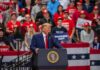


Trump’s anti-communist message at Wheeler High School matters less as a single line of rhetoric than as a case study in how he uses ideological language: communism is presented not as a policy disagreement but as a solvent that rots institutions, blights children’s prospects, and renders civic life decadent. The controversy around the speech also shows how quickly a school venue turns a policy rollout into a legitimacy fight over whether the event was educational, partisan, or something closer to a campaign rally.
Key Points
- Trump used the Wheeler High School appearance to make a familiar argument: communism produces social and institutional decay, not just bad economics.
- The immediate backlash was aimed less at rebutting the ideology claim than at the venue itself; critics objected to a public high school being used for a political spectacle.
- The district and White House framed the visit as a policy event centered on Trump Accounts, which made the clash over interpretation sharper, not softer.
- The viral line about his wife disliking his language underscores Trump’s style: blunt moral condemnation wrapped in showman’s timing and profanity.
What Trump Was Doing Rhetorically
Trump’s communism language is not accidental flourishes at the edge of a speech; it is a governing idiom in his political communication. In the Wheeler remarks, he reportedly repeated the now-familiar theme that communism leads to “death, destruction, and squalor,” and another account of the same speech says he called communism the “single greatest threat” to the country and accused the radical left of trying to destroy children’s futures with it. That is classic Trump framing. He compresses a large ideological argument into a moral binary: freedom versus ruin, prosperity versus collapse, America versus an imported pathology.
The profanity matters because it makes the line memorable without changing the underlying structure of the argument. “With communism, everything turns to sh*t” is not a policy analysis; it is a totalizing verdict. The joke about his wife disliking the language gives the line a comic coda, but it also serves a familiar purpose in Trump’s style: he uses humor to soften the delivery of a hard-edged claim, then lets the bluntness do the political work. The effect is less about precision than about emotional compression.
Why the Venue Became the Real Battleground
The dispute around Wheeler High School quickly shifted away from communism itself and toward the propriety of hosting a presidential appearance at a public school. USA Today described the event as a visit to discuss the newly launched Trump Accounts, a tax-advantaged savings program for children, while local coverage said the school setting would amplify remarks about the future of young Americans. That institutional framing mattered because it gave the event an educational gloss even as the political content was obvious to critics. Once a public school becomes the stage, every message delivered there is scrutinized as an act of institutional symbolism, not just a speech.
That is why the backlash was so immediate and so visible. Newsweek reported that dozens of community members booed at a Cobb County school board meeting after a video recap of the visit was shown, and AJC reported that more than a dozen speakers blasted the district for allowing the school to become the stage for a political rally. In other words, the fight was not mainly over whether Trump opposes communism; it was over whether a school district should host a president in a way that looks, to critics, like partisan mobilization. The same event can be a policy rollout to one side and a political intrusion to the other. Here, both readings were already in circulation before the microphones were even off.
What the Available Counter-Evidence Actually Shows
The strongest counter-evidence does not refute Trump’s anti-communist claim on the merits; it reframes the controversy around context, optics, and venue. The record supplied here contains no transcript-level rebuttal showing that opponents challenged his causal argument about communism producing institutional decay. Instead, the objections documented in local coverage focus on partisanship, school governance, and the symbolism of the setting. That is an important distinction. A lot of public argument is about whether a statement is fair, but this one was mostly about whether the speaker belonged in that room at all.
The district’s own defense reinforces that point. USA Today reported that the school district treated the appearance as an honor, and superintendent Chris Ragsdale defended the visit at the board meeting while emphasizing that the district had been selected by the White House. That defense did not answer Trump’s ideology claim; it answered an institutional legitimacy question. The result is a split-screen controversy: one layer about communism, another about governance. The second layer is where the loudest evidence sits.
The Broader Political Pattern Behind the Clip
This episode fits a larger pattern in modern American politics: a high-visibility appearance at a civic institution becomes a second story about whether the institution has been used for messaging that feels propagandistic or partisan. The research package shows that the Wheeler visit was billed around Trump Accounts and future-oriented policy, but reported and remembered through protests, boos, and the language of rally politics. Schools are especially combustible venues because they carry a public expectation of neutrality; when a president uses one as a stage, the line between public service and political theater becomes hard to police.
Trump understands that dynamic and exploits it. He does not merely argue that communism is bad; he places that argument inside a charged institutional setting, then delivers it in language designed to travel well outside the room. That is why the line became a clip. The speech worked on two levels at once: substantively, it reinforced his long-running anti-communist posture; theatrically, it supplied the kind of quotable, polarizing sound bite that can dominate coverage even when the event itself was officially organized around something else.
I would suggest to the Cobb county residents that took offense to the President speaking at Wheeler high school to remember that what he was speaking on were Trump accounts that give every child who registers $1000 and if funded into their future could let them graduate high…
— cardinal157 (@cardinal157) July 24, 2026
Why the Statement Resonates With Trump’s Base
Trump’s anti-communism works because it is not confined to the historical meaning of communism as an economic system. In the coverage cited here, the term functions as a catch-all for social breakdown, moral inversion, and elite overreach. That elasticity gives the rhetoric power. To supporters, “communism” can name a wide set of grievances: dependency, cultural radicalism, bureaucratic control, and the sense that institutions are drifting away from ordinary citizens. To critics, the same elasticity is precisely the problem, because it collapses distinct arguments into one ideological alarm bell.
That is also why the line about “everything turns to sh*t” lands. It is crude, but it is structurally efficient. It converts a complicated historical ideology into a simple picture of decay, and it does so in a register that is unmistakably Trump’s. Whether one takes the claim literally or metaphorically, the mechanics are the same: the language is designed to produce recognition, not debate. In that sense, the Wheeler remark is less an isolated outburst than a clean expression of how Trump now talks about the political world—through catastrophe language, vivid contempt, and the promise that he alone sees the threat clearly enough to name it.
Sources:
thegatewaypundit.com, newsweek.com, facebook.com, wsbradio.com, cobbcountycourier.com, youtube.com, ajc.com