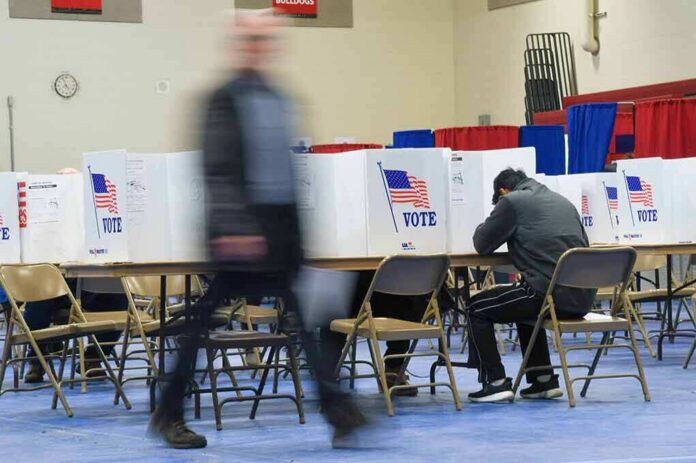
Federal power is moving closer to the ballot box as agencies harden election oversight and courts fight over mail voting rules.
Story Highlights
- The Federal Bureau of Investigation (FBI) expanded election-crime coordination in all field offices.
- FBI Director Kash Patel would not rule out agents at polling places during a Senate hearing.
- President Trump’s order to tighten mail ballot handling triggered lawsuits reaching the Supreme Court.
- Election officials brace for threats and delays while saying fraud remains rare.
What Changed: Federal Agencies Step Deeper Into Elections
FBI Director Kash Patel told senators that each of the bureau’s 56 field offices now has an election-crimes coordinator. He said agents and analysts will be positioned for election interference matters because “election integrity is of paramount importance”. Patel declined to rule out sending agents to polling places, a step supporters call necessary and critics call chilling. The Justice Department also signaled tougher action in the run-up to November, highlighting ongoing federal attention to the vote.
President Trump signed an executive order on March 31, 2026 directing the Postal Service to propose rules that tighten control of mail-in ballot transmission, including state-specific eligibility lists. The rule drew fast legal challenges claiming the Postal Service overstepped and risked blocking valid votes. The litigation reshaped before the Supreme Court, which weighed emergency requests tied to the rule’s rollout. The clash shows federal control over ballot logistics is now a central fight, not a theory.
Why It Matters: Counting Speed, Trust, and Conflicting Risks
County officials told Reuters they are preparing for misinformation, cyberattacks, and possible intimidation. Some even voiced fears about sudden federal seizures of ballots after a high-profile raid in Georgia. They expect slow counts in close races and warn that delay can fuel doubt. Yet many of the same officials say fraud remains rare and that their systems are secure, a message meant to calm both parties’ voters.
These tensions hit a nerve for many Americans who already doubt Washington. Voters on the right worry about unsecured mail ballots and results that flip days later. Voters on the left fear suppression, intimidation, or heavy-handed federal moves at the polls. The FBI’s posture and the Postal Service rule offer each side evidence for its concerns. The result is a feedback loop: more security steps meant to build trust can look like control or interference to skeptics.
The Legal and Political Stakes Before November
Senate Democrats urged the Postal Service to halt its mail ballot rulemaking, arguing it risks disenfranchising eligible voters and turns a delivery agency into an election authority. Their letter framed the rule as an illegal shift in who runs the process. Separately, the Supreme Court declined a Justice Department request to pause an injunction that blocked parts of the Postal Service rule, keeping restrictions on hold while cases continue. That leaves states in a patchwork as deadlines near.
The Department of Justice said it will take aggressive actions to secure the midterms, highlighting recent charges for unlawful voting and registration. Supporters say that shows enforcement is real, not theater. Critics say isolated arrests do not prove widespread fraud and should not justify sweeping controls that can slow or block legal ballots. Both points can be true at once: targeted crimes exist, but that does not establish a national plot or a broken system.
How Citizens Can Read Delays Without Losing Faith
Close races often take days to settle because mail ballots arrive near deadlines and must be checked. Some states process those ballots later by law, which creates a “blue shift” or “red shift” as different types of votes are counted. That timing pattern can look suspicious if you expect instant results. Experts and many election officials say patience and clear rules reduce distrust, but only if leaders stop framing routine steps as proof of cheating.
Bottom Line: More Oversight, More Doubt, and a Narrow Path to Trust
Federal coordination, new Postal Service rules, and active court fights show this election will run under tighter scrutiny than most. That will reassure some and alarm others. The record so far confirms tough rhetoric, sharpened security, and real legal clashes. It does not confirm a large fraud scheme. The shared interest is simple: count all legal votes, reject illegal ones, finish faster, and explain every step in plain language so citizens do not feel the system belongs to insiders alone.
Sources:
thegatewaypundit.com, x.com, inquirer.com, nytimes.com, inkl.com, cnn.com, democrats-judiciary.house.gov, govexec.com, democracydocket.com, cbsnews.com