
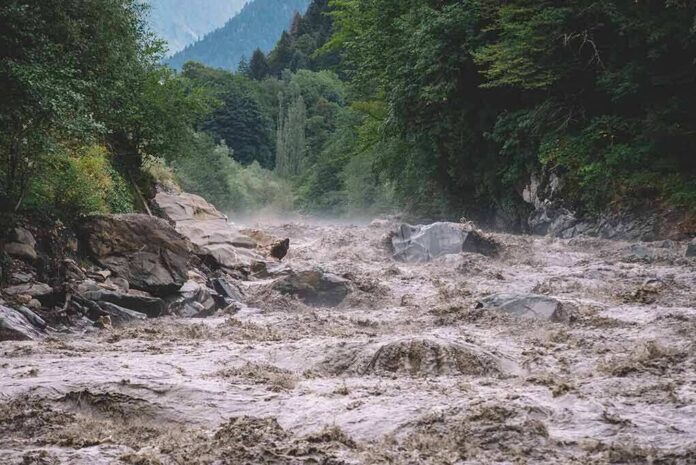
A sudden, debris-filled surge on Nepal’s Budhi Gandaki River swept away dozens of homes and key bridges, forcing villagers to flee in the dark.
Story Highlights
- Flash flooding destroyed houses and bridges in Gorkha’s mountain valleys.
- Local officials reported about 35 homes lost across several settlements.
- Authorities warned residents to move to higher ground as the river rose.
- A suspected landslide blockage likely triggered the sudden surge.
Flash Flood Slams Remote Gorkha Settlements
Residents along the Budhi Gandaki River in Nepal’s Gorkha district evacuated as a violent flash flood tore through riverside settlements on October 11, 2026. The debris-laden surge destroyed homes and bridges in Chumnubri and nearby areas. Reporters on the ground described villagers moving out before dawn after hearing the river roar. Authorities said water levels rose fast and carried mud, rocks, and logs. Early reports showed extensive damage across several wards and market areas.
Police and local leaders urged families near the river to head for higher ground. Nepal’s flood forecasters issued a warning advising people to stay away from the river and relocate to safe places. Officers in the district said they alerted residents in Sirdibas and parts of Dharche to leave at once. Several settlements, including Chumling and Lokpa, saw people moving out after loud river noise signaled danger. Officials emphasized safety and told people to avoid damaged crossings.
Damage Tally Centers on Dozens of Homes and Multiple Bridges
Local officials in Chumnubri Rural Municipality reported that about 35 houses were swept away across multiple locations. The figure came as teams checked Paiyu, Bagar, Dobhan, Ghettekhola, Jagat, and Salleri. Reporters also described widespread damage to markets and roadside structures. While counts varied by outlet and location, the combined picture showed severe losses to homes and livelihoods. Early coverage said the damage spanned a long stretch downstream as water surged through narrow gorges.
Bridge failures cut vital links between mountain communities. Reports said two suspension bridges and one iron-and-concrete bridge were destroyed. Those crossings connected Nyakchet with Sirdibas, Kerauja with Machhakhola, and Soti with adjoining Arughat wards. These spans serve as lifelines for trade, food, school access, and medical care in steep terrain. Their loss will slow relief and make recovery harder. Engineers will need to inspect banks before any rebuilds begin.
Landslide Blockage Likely Triggered Sudden Surge
Officials and reporters pointed to a likely landslide that blocked the river upstream before the flood. A natural dam can form when earth and rock fall into a narrow channel. When that dam breaks, water and debris can rush downstream in minutes. Outlets described a suspected blockage between Lokpa and Chumling within Chumnubri. This hazard aligns with Nepal’s pattern of steep slopes, loose soils, and sudden releases after slides, especially during wet or unstable periods.
🚨🇳🇵 BREAKING: DEVASTATING FLASH FLOODS HIT #NEPAL !
A massive flash #flood in the Budhi Gandaki River has swept away more than 35 houses and several bridges in #Gorkha district today, October 11. 🌊 pic.twitter.com/nKwNfR6LnU
— World_Breaking_News03 (@Breaking2003) October 11, 2026
Emergency teams focused first on moving people to safety and checking for injuries. One report said there were no confirmed deaths at the time of its release, but officials still worked to assess remote hamlets. Moving through the valleys is slow after bridge loss, rockfall, and damaged footpaths. Authorities warned residents to stay clear of banks and unstable slopes. They prepared for more shifts in water level as debris continued to move downstream.
Why This Matters Far Beyond Nepal
Mountain floods like this are a warning for every country that depends on aging bridges, thin emergency budgets, and slow alerts. When a river jumps its banks, the first needs are simple: clear warnings, safe roads, solid spans, and quick help. Many Americans feel our own systems are not ready for fast disasters. They worry that leaders fund pet projects while neglecting basic safety. This event shows how fragile life can be when key links fail.
Better monitoring and faster alerts save lives. Nepal’s warning helped people get out of harm’s way. But warnings must be tied to real options to move, including sturdy routes and safe shelters. In the United States, many towns face floods, fires, or storms with dated maps and weak bridges. Both the left and the right agree on this: basic infrastructure should come first. When crisis hits, people do not need speeches. They need working systems that put them first.
Sources:
thehindubusinessline.com, apnews.com, english.nepalnews.com