
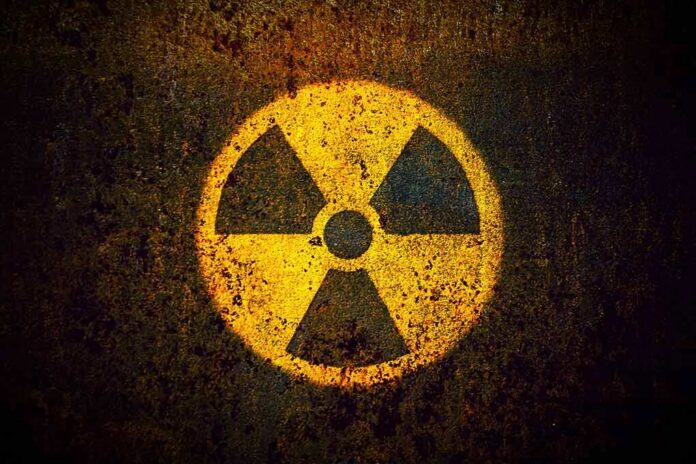
A fire inside a nuclear research lab in South Carolina set off a site-wide emergency and a temporary no-fly zone Wednesday night.
Quick Take
- A fire broke out in a single room at Savannah River National Laboratory, reported at 5:39 p.m. Wednesday.
- Officials declared a Site Area Emergency, the second-highest level in the federal emergency system.
- Savannah River Site said an “unfiltered ground-level radiological release” happened, but no contamination left the facility.
- The Federal Aviation Administration (FAA) restricted flights near the site, calling it a “nuclear incident.”
- The emergency ended that same night, with traffic restored at all site checkpoints by 9:18 p.m.
Fire Breaks Out in Nuclear Lab Room
A fire started inside a single room at Savannah River National Laboratory in Aiken, South Carolina, on Wednesday evening. Savannah River Site officials reported the fire at 5:39 p.m. and said it came with an “unfiltered ground-level radiological release”. The fire was later put out. Officials said the blaze stayed contained to that one room and did not spread further through the lab building.
Savannah River Site has run as a major U.S. Department of Energy complex for decades, handling nuclear materials tied to both research and past weapons work. A fire paired with any mention of a radiological release at a site like this draws fast attention, since it touches both public safety and the government’s handling of sensitive nuclear material.
Officials Declare Site Area Emergency
Site officials declared a Site Area Emergency, a formal federal classification used when an event could seriously affect safety functions at a facility. Workers at the site were told to shelter in place. Officials restricted incoming traffic and temporarily closed rail, river, and air routes near the complex as crews responded to the fire and checked for any spread of contamination.
Despite the serious classification, officials said the danger stayed inside the facility’s walls. A Savannah River Site statement said “there was no indication of contamination beyond the site’s boundaries”. A separate statement echoed that, saying no contamination had been reported outside the affected building. Neither statement detailed what materials were involved or how much radioactive material, if any, escaped the room.
Federal Aviation Restrictions Added to Response
The FAA issued a temporary flight restriction over the area, describing the event as a U.S. government “nuclear incident”. That order grounded aircraft near the site while emergency crews worked. The restriction gave outside confirmation that federal authorities treated the fire as serious enough to limit air traffic, even as site officials maintained that the danger had not spread beyond facility grounds.
How Nuclear Emergencies Are Classified
The Department of Energy ranks operational emergencies in three rising levels: Alert, Site Area Emergency, and General Emergency. A Site Area Emergency can be declared when a facility loses control of hazardous material or when safety systems fail, even if radiation levels outside the site stay below limits that would trigger public protective action. Nuclear Regulatory Commission guidance uses a similar standard, meaning this level of alert does not by itself prove the public faced direct danger.
Emergency Lifted Hours Later
The site’s emergency-management team reported that by 9:18 p.m. Wednesday, no active emergencies remained and that traffic had been restored through all barriers. The quick end to travel restrictions and shelter orders matched officials’ claim that the fire had been fully put out and that the radiological release stayed inside the one affected room, without reaching areas beyond the lab building.
Officials have not released the cause of the fire, the type or amount of material involved in the release, or whether any workers were exposed or hurt. Those details were not part of the statements given to local media on the night of the fire, leaving the full technical picture of the incident still to come from the Department of Energy and site officials.
Here is a headline nobody wants to see.
Emergency issued in South Carolina. A fire erupted at the Savannah River National Laboratory in South Carolina, triggering a Site Area Emergency at 5:39 p.m. on Wednesday. Fire crews extinguished the blaze roughly two hours later, and…
— Daniel C. Green | The Eagle Eye (@TheEagleyeNews) October 29, 2026
For now, the public record shows a contained fire, a fast-declared emergency, and an equally fast stand-down, backed by both site officials and the FAA’s independent flight restriction. The event adds to a string of recent incidents at federal nuclear facilities that test public trust in how agencies report risk, even when the stated outcome is that no one outside the gates was harmed.
Sources:
nypost.com, wrdw.com, themirror.com, wsbradio.com