

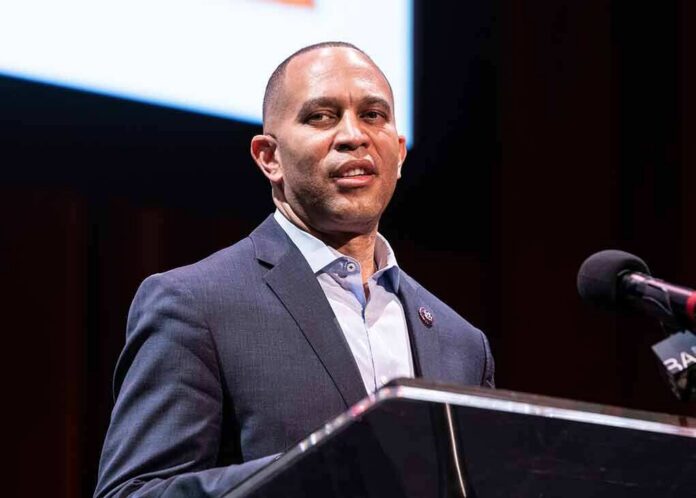
A brief hallway exchange with House Democratic Leader Hakeem Jeffries is fueling a fierce debate over whether Congress should try to undo third‑country deportations already carried out by the federal government.
Story Snapshot
- A viral clip shows Hakeem Jeffries nodding when asked if Democrats would bring back people deported to third countries; the clip lacks a full transcript or detailed plan.
- Jeffries has condemned the administration’s “extreme” enforcement approach and opposed more funding for it in House statements.
- An appeals court found the third‑country process violated due process on notice and hearing grounds, raising legal questions about prior removals.
- Homeland Security officials defend third‑country removals as an essential public‑safety tool for hard‑to‑remove cases.
What the hallway exchange shows—and what it does not
On October 27, a conservative outlet posted video of Hakeem Jeffries in a hallway. A reporter asked if Democrats would bring back people deported to third countries, such as in Africa. The report says Jeffries nodded several times and said, “We do.” The post stresses he did not say “yes” out loud. The clip does not include a full transcript or clarify whether he meant physical return, new hearings, or ending funding going forward.
The same report quotes Jeffries attacking the administration’s enforcement as “extreme” and calling for “fair, just, and humane” policies. That stance fits other public comments where he opposed more money for Immigration and Customs Enforcement and Customs and Border Protection under a Republican budget plan this year. But no cited Democratic bill or plan details a process to return all deported people from third countries.
The legal fight over third-country removals
Third‑country removals move a person to a nation that is not their home country. Human Rights Watch and news outlets have reported on cases where people said they lacked notice or a chance to explain fears of transfer. In September, a federal appeals court ruled the process violated due process because migrants were not given sufficient notice or a real chance to raise fear of transfer. The ruling targets procedures, not a blanket order to bring everyone back.
Court orders on notice and hearings can lead to case reviews or new screenings. They do not, by themselves, prove that every removal was unlawful. They also do not require Congress to fund return flights. The scope of any remedy will likely depend on individual facts, ongoing litigation, and agency guidance. Without clear remedial language, claims of a mass return remain unproven in the public record.
Why the policy exists—and critics’ cost and oversight claims
Department of Homeland Security leaders say third‑country removals are needed when a home country refuses return, when return is unsafe, or when logistics block removal to the country of origin. They argue the tool helps remove people with final orders, including some accused of serious crimes. The department also says the State Department seeks diplomatic assurances that transferees will not face persecution or torture before removal.
Democratic lawmakers and advocates question both the morality and the management of the program. Reporting describes a program cost in the hundreds of millions and limited public oversight. One cited senator called it “costly, wasteful and poorly monitored,” urging deeper scrutiny. These claims mirror a broader concern on both left and right that large federal programs run in the dark, waste money, and face little accountability to taxpayers.
Shared voter worries: clarity, costs, and control
Voters across the spectrum see a federal system that often hides the ball. Conservatives worry about weak borders, crime, and high costs. Liberals worry about due process, family separation, and unequal treatment. Both sides resent policies built through opaque deals and sprawling contracts. The record here shows unclear procedures, big spending, and clashing claims—exactly the kind of mix that feeds distrust of Washington’s motives and management.
DHS lays out the "egregious" criminal illegal aliens deported to third countries, and 60 Minutes thinks the REAL scandal is where ICE sent them?! More CBS bullshit. Keep the deportation flights coming, ICE!! 🇺🇸🇺🇸🇺🇸
— Scott (@cathlabscott) October 27, 2026
What to watch next: a verified full recording or transcript of the Jeffries exchange; any official Democratic policy text on remedies for those already removed; court orders that spell out who, if anyone, must be returned; and Government Accountability Office or inspector audits that map the program’s true costs. Clear records—not viral clips—will decide whether Congress aims to bring people back or to fix procedures going forward.
Sources:
thegatewaypundit.com, fatelephant.com, theafricareport.com, npr.org, jeffries.house.gov, abcnews.com, apnews.com, newsweek.com, washingtonpost.com