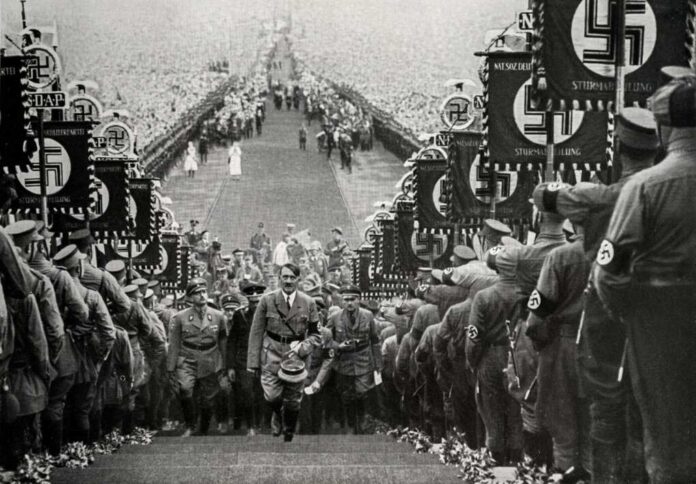
Could modern teenagers unknowingly spread Nazi-era myths, echoing the sinister propaganda of Heinrich Himmler?
Story Highlights
- Concerns rise over teenagers spreading Nazi-era pseudoscience on social media.
- Himmler’s obsession with Aryan supremacy myths echoes in today’s digital age.
- The unchecked spread of misinformation threatens to normalize extremist views.
- Historical indoctrination methods offer a cautionary tale for modern society.
Digital Echoes of a Dark Past
In the age of social media, a troubling trend emerges: teenagers may unwittingly share content linked to Heinrich Himmler’s favorite myths, rooted in Nazi-era pseudoscience. These myths, particularly those promoting Aryan racial superiority, are resurfacing in online platforms. The digital age lacks the rigorous checks that once controlled such ideas, allowing them to spread unchecked, potentially normalizing extremist views among impressionable youths.
Heinrich Himmler, a pivotal figure in Nazi Germany, used the SS and the Ahnenerbe to propagate these myths, aiming to prove Aryan dominance through pseudoscientific means. This historical context underscores the dangers of unchecked propaganda, as social media algorithms inadvertently amplify similar messages today, threatening to erode critical thinking and promote extremist ideologies.
‘This is no longer history, it is a warning’ – survey finds widespread Holocaust denial encountered by young people online https://t.co/dsYHutQ5Pg
— Irish Independent (@Independent_ie) January 21, 2026
The Historical Context of Nazi Indoctrination
The roots of these myths trace back to the 1920s, when Nazi indoctrination targeted youth to embed racial ideologies. Himmler, born into a conservative family and rising as the SS chief, was instrumental in promoting Aryan supremacy through fabricated historical narratives. This indoctrination aimed to create a generation of loyal followers who would uphold Nazi ideals, a goal disturbingly mirrored by today’s unregulated digital platforms.
By 1936, membership in youth groups like the Hitler Youth became mandatory. These groups indoctrinated millions through physical and ideological training, preparing them for future roles in the Nazi regime. This systematic indoctrination highlights the power of controlled messaging, a stark contrast to today’s decentralized and algorithm-driven spread of information.
Modern Implications and Risks
Today, the rapid spread of misinformation through social media poses a significant threat, echoing the propaganda techniques of the past. While there is no direct evidence linking current social media trends to Himmler’s specific myths, the potential for digital platforms to disseminate similar ideologies remains a pressing concern. The unchecked nature of these platforms allows for rapid and widespread dissemination of extremist content, threatening societal norms and values.
As we navigate this digital landscape, the lessons of history remind us of the importance of vigilance. Just as Nazi Germany used education and youth programs to shape ideologies, modern platforms must recognize their role in curbing the spread of extremist views. By understanding the past, we can better protect future generations from the dangers of misinformation and ideological manipulation.
Sources:
Indoctrinating Youth
Controlling Everyday Life: Young People
Propaganda in Nazi Germany
Heinrich Himmler