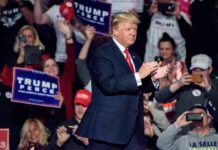
An anonymous-diplomats leak is now being used to paint President Trump as “dangerous,” and the real question is whether Americans are watching a political smear machine at work—or a legitimate allied warning.
Story Snapshot
- Politico reported that Slovak Prime Minister Robert Fico privately questioned Trump’s “psychological state,” citing unnamed European diplomats.
- The White House and Slovakia issued categorical denials, calling the report “fake news” and “lies,” with Fico insisting “no one heard anything.”
- The episode lands amid wider media focus on Trump’s age and fitness, fueled by critics and recent gaffe-driven headlines.
- Because the central allegation rests on anonymous sourcing, the public record currently cannot confirm what was allegedly said in closed-door settings.
What Politico Alleged—and What Officials Flatly Denied
Politico reported that European diplomats claimed Slovak Prime Minister Robert Fico told counterparts at a recent summit he was worried about President Donald Trump’s “psychological state,” allegedly calling him “dangerous” after a January 17, 2026, meeting at Mar-a-Lago. Within hours, the White House rejected the claim and characterized the meeting as “positive and productive.” Slovakia also denied it, with Fico insisting the story was fabricated.
The timeline is clear even if the quote is not. Multiple outlets reported that Fico met Trump on January 17 and later described the talks as “exceptionally important,” then Politico published its account on January 28. Denials followed immediately and were repeated into January 29. The key uncertainty is evidentiary: the purported remarks are attributed to unnamed diplomats, with no direct recording or on-the-record witness produced in the material provided.
Why This Story Has Legs: Age, Optics, and a Media Incentive Structure
Trump is 79 and turns 80 in June 2026, which keeps presidential health in the headlines regardless of policy outcomes. Critics have circulated clips and anecdotes—such as claims about dozing or bruising—while defenders point out that speculative health narratives often substitute for actual governance coverage. The research here includes commentary on alleged speech miscues and other incidents, but it also notes the absence of medical evidence and the lack of official disclosure.
One reason the story gained traction is the “ally angle.” Fico is generally described as a nationalist aligned with Trump on several themes, which makes the alleged quote more newsworthy than routine criticism from political opponents. That said, the strength of the underlying claim still depends on anonymous sourcing. Conservative readers should recognize how frequently “senior official” and “diplomat familiar with the matter” sourcing gets used to shape public perception without accountability—especially when the target is a president challenging Europe on tariffs and burden-sharing.
The Fico Factor: Nationalist Ally, or Convenient Vehicle for a Narrative?
Fico’s public posture in this episode matters because it is one of the few hard facts available. He denied the report and attacked Politico as ideologically hostile, claiming the outlet invented the remarks and that no one at the summit heard such a statement. If Fico is telling the truth, the situation illustrates how quickly foreign-policy gossip can be laundered into “reported fact” through unnamed intermediaries, then echoed by larger outlets.
At the same time, the denials do not automatically disprove the leak. Leaders sometimes walk back private comments to avoid diplomatic fallout, and closed-door summits rarely generate verifiable transcripts. The most responsible conclusion from the provided record is narrow: there is a claim, there is a denial, and there is no independently confirmed documentation in the research proving the exact wording. That is not satisfying, but it is honest—and it prevents readers from being stampeded.
What’s Actually at Stake: Trust, Diplomacy, and “Fitness” as a Political Weapon
The immediate impact is reputational. Stories about a president’s mental state can weaken negotiating leverage, rattle allies, and fuel internal political escalation—especially with talk of constitutional mechanisms like the 25th Amendment floating around in media ecosystems. The long-term risk is institutional: if “fitness” becomes a routine substitute for policy debate, voters get less transparency on budgets, borders, and security, while unelected actors gain influence through narrative pressure.
Europe-U.S. tensions cited in the research—tariffs, NATO posture, and disputes involving Greenland—create fertile ground for psychological-story framing because it shifts attention from interests to personalities. A separate analysis referenced in the research discusses “narcissistic” alliance dynamics at the country level, but it is not a clinical diagnosis and should not be treated as one. What can be said factually is that strained alliances make rumor-driven diplomacy more potent and more dangerous.
Sources:
https://newrepublic.com/post/205474/donald-trump-cognitive-decline-ty-cobb
https://www.nbcrightnow.com/national/white-house-slovakia-deny-report-on-trumps-mental-state/article_de4d409d-2dab-5e97-8b44-b8b02ff64256.html
https://www.straitstimes.com/world/united-states/white-house-slovakia-deny-report-on-trumps-mental-state
https://gppi.net/2025/10/12/when-your-ally-turns-narcissistic
https://www.lindaikejisblog.com/2026/1/trump-ally-says-heas-worried-about-his-adangerous-psychological-statea.html