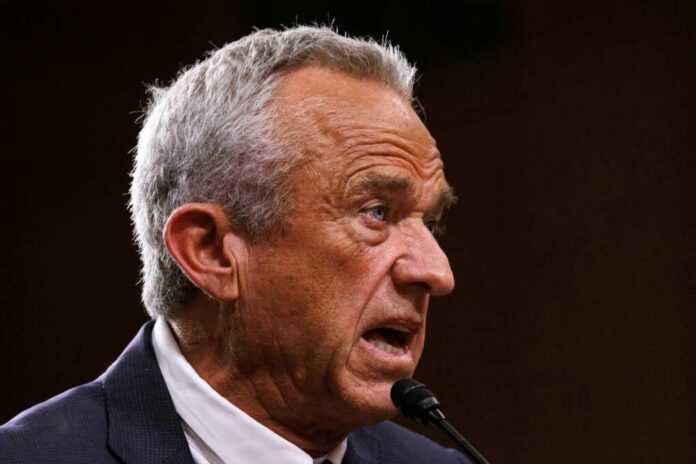
RFK Jr.’s plan to “de-prescribe” antidepressants is colliding with a hard reality: millions rely on SSRIs, and the government may not have the therapy access or evidence base to replace them safely.
Quick Take
- HHS Secretary Robert F. Kennedy Jr. is advancing a “Make America Healthy Again” initiative aimed at reducing antidepressant use, including clinician training to support de-prescribing for Medicare patients.
- Kennedy has pushed federal agencies to study potential links between SSRIs and mass violence, a claim many psychiatric experts dispute as correlation rather than causation.
- Critics warn stigma and rushed tapering could deter treatment, pointing to past policy shocks—like the 2004 youth SSRI warning era—associated with higher suicide rates.
- Supporters see the push as a long-overdue challenge to pharma-driven medicine and a pivot toward lifestyle and “root cause” health strategies.
What RFK Jr. Is Actually Doing at HHS
Robert F. Kennedy Jr., serving as Secretary of Health and Human Services, has moved his MAHA agenda from rhetoric into agency action. Recent reporting describes a strategy that emphasizes reducing antidepressant use—especially SSRIs—while promoting non-pharmaceutical alternatives such as exercise, diet changes, and therapy. As of early May 2026, a key operational step is clinician training focused on “de-prescribing,” including for Medicare patients, though public details about funding and capacity remain limited.
Kennedy’s approach is politically resonant in a country exhausted by rising costs and distrust of elite institutions. Many conservatives hear “de-prescribing” and think accountability: fewer permanent medications, less dependence on corporate systems, more personal responsibility. At the same time, mental health care isn’t a simple consumer choice. The core policy question is whether the federal government can encourage safer, more selective prescribing without creating pressure to discontinue drugs that many patients say keep them functioning.
The SSRI–Violence Theory: Evidence Gaps and Political Fuel
Kennedy’s most controversial move has been urging studies on whether SSRIs or other psychoactive drugs are linked to mass violence or school shootings. The initiative gained attention after he tied a Minnesota school shooting to SSRIs in 2025 and later used social media to signal federal involvement, with CDC and NIH positioned to study the issue. Psychiatric experts quoted in coverage argue the evidence does not show causation, warning that severe depression itself can be a confounding factor.
That distinction matters because government-led messaging can reshape behavior even before results arrive. If official rhetoric suggests SSRIs are a “violence risk,” patients may quit abruptly or avoid starting treatment, while families may stigmatize those already taking medication. The current reporting also indicates there are no completed 2026 federal study results yet, meaning the public debate is running ahead of definitive findings. In a polarized environment, early impressions often stick—regardless of later data.
The 2004 Warning Lesson: When Policy Shifts Backfire
Several sources point to a precedent conservatives and liberals alike should remember: the 2004 FDA black-box warning era for youth suicidality. After warnings and heightened fear, youth SSRI prescribing reportedly dropped 20–30%, and later analyses cited in coverage associate that period with increased suicides—without any clear benefit related to violence reduction. The takeaway is not that warnings are always wrong, but that broad alarm can trigger unintended, deadly consequences if off-ramps are not in place.
For a government already criticized as failing basic competence, this is the credibility test. A cautious, evidence-first approach would separate two tasks: improving informed consent and tapering practices for patients who want to stop, while protecting access for patients who need medication. The risk is that a political “war on antidepressants” framing turns a nuanced clinical decision into a top-down campaign. That would deepen public distrust and validate fears of a bureaucracy treating citizens as statistics.
The Access Problem: Therapy Isn’t a Magic Substitute
Even if a large share of Americans could benefit from lifestyle changes, therapy, or non-drug supports, access remains a structural bottleneck. Advocacy reporting highlighted a stark barrier for seniors: a large share of therapists do not accept Medicare, pushing many patients into out-of-network costs. That matters because the new de-prescribing push explicitly includes Medicare patients. Without parallel reforms—provider availability, reimbursement, rural access—“switch to therapy” can become an unfunded mandate on families.
RFK Jr. Launches His Latest MAHA Project — Getting Americans Off Antidepressants https://t.co/bAi3H4k9xb
— Jim Meadows (@jcmeadows) May 6, 2026
The most durable solution may look less ideological than either side wants. Conservatives are right to demand transparency, challenge over-medication, and resist pharmaceutical capture of public health. Liberals are right to fear stigma and sudden treatment disruption for vulnerable people. If MAHA is going to earn trust beyond its base, it will need clear guardrails: voluntary patient choice, physician-led tapering protocols, and measurable expansions in mental health access—rather than pressure, headlines, and bureaucratic ambition.
Sources:
RFK Jr. linking antidepressants to mass violence MAHA
Secretary Kennedy antidepressants MAHA Commission letter
Anxiety treatment SSRI medications RFK Jr.
RFK Jr.’s anti-antidepressant campaign has a Trump budget and access problem
RFK Jr antidepressants teenagers warnings