
France has made thousands of arrests and shut hundreds of schools but still stopped short of declaring a national emergency.
Story Snapshot
- Roughly 5,000 people have been detained as school protests spread nationwide.
- Hundreds of schools closed, with reported arsons and clashes alongside many peaceful marches.
- Officials cite youth-led grievances over education conditions, not a coordinated insurrection.
- Conflicting counts and graphic images fuel confusion that both sides can exploit.
What happened across France this week
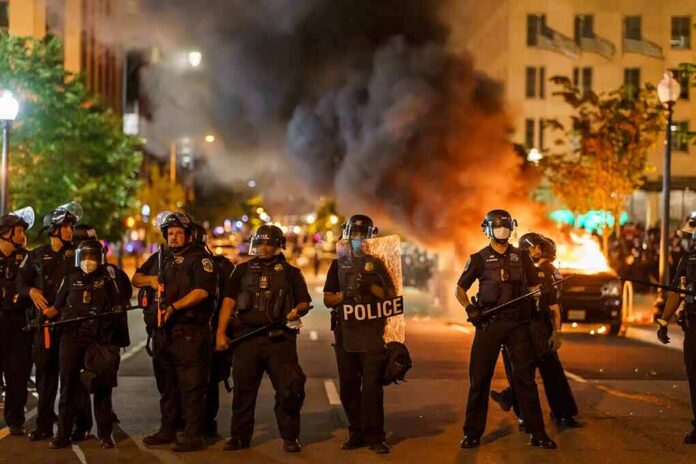
French cities saw large student-led protests over school conditions. The Interior Ministry reported about 5,000 detentions since Monday, most of them minors, as police faced fires, vandalism, and clashes in several areas. The Education Ministry said hundreds of schools closed due to safety risks, while some facilities were burned or ransacked. Agency estimates put nationwide turnout at about 256,000 people, including tens of thousands in Paris, showing both scale and spread across the country.
Officials also reported injuries among students and police. Reports described at least 190 injured students and a 15-year-old boy who reportedly lost a hand during clashes in the city of Lens, though the cause is not fully established in public records yet. Police and gendarmes also counted hundreds injured during the unrest. These facts fueled calls for tougher action from some voices, while others argued for restraint and dialogue with students.
Why France did not invoke emergency powers
Government leaders framed the response around targeted policing and the right to peaceful protest. The Interior Minister said police should intervene when violence occurs while acting with proportional force, and the Prime Minister urged officials to hear students’ concerns and seek solutions. This line separates peaceful marches from criminal acts. It also signals that officials believe regular law and policy tools, not emergency law, still fit the moment.
France has a long and contested history with emergency powers. The 1955 state-of-emergency law allows curfews, expanded searches, and restrictions on movement. Leaders invoked it during the 2005 riots and again after the 2015 terror attacks, and in both periods critics warned about overreach while officials cited urgent risks. Against that backdrop, refusing to invoke emergency powers now looks like a deliberate choice to avoid exceptional steps unless clearly required.
The core grievances behind the marches
Students and teachers say schools face overcrowding, staff shortages, overheated classrooms, and aging buildings. Those claims drove blockades and walkouts at many high schools. Government statements and reporting linked the mobilization to these education issues, even as small groups committed arson or fought police near some marches. This mix complicates the narrative. Many young people marched peacefully. Some others turned to property damage that forced shutdowns and urgent repairs.
France in flames.
Riots in more than 20 French cities.
Chaos explodes nationwide as streets turn into battlegrounds.
Widespread looting, arson and vandalism.
Emergency responders under siege.
This crisis is escalating rapidly. pic.twitter.com/T3jWF3pXD6
— Michael Snyder (@Revelation1217) October 18, 2026
Advocacy groups added that most protests were peaceful and warned against blanket crackdowns. Human Rights Watch argued that heavy-handed policing risked punishing many for the acts of a few, while the state insisted on breaking school blockades and stopping violence quickly. The Education Minister also said non-students had hijacked some actions, which suggests opportunists worsened disorder while masking deeper school problems that remain unresolved.
Why the numbers and images feel so confusing
Different outlets cited different arrest and school-closure totals, sometimes over shifting time frames. Reports referenced about 5,000 to more than 6,100 arrests, and hundreds up to nearly 900 affected schools, depending on how they counted closures or disruptions. Such gaps let officials or critics pick the figure that best fits their case. Meanwhile, video clips of fires and tear gas shape opinion faster than spreadsheets, even though many marches were calm.
This confusion matters for trust. People across the political spectrum worry that leaders spin crises to grab more power or escape blame. Here, French officials stress proportionate policing and dialogue, while keeping up arrests and prosecutions for violence. That approach may reassure those who fear emergency rule. It will frustrate those who see vandalism and ask why the state does not do more. Either way, the proof will be in transparent data and steady outcomes.
What to watch next
Watch whether the arrest and injury counts stabilize with clear definitions. Track how many schools reopen and how fast repairs happen. Look for talks that address staffing, class sizes, and building fixes, not just security steps. If violence fades while schools improve, the case against an emergency declaration will look stronger. If disorder grows or spreads, pressure for tougher measures will rise, and the debate over liberty, order, and trust will return to center stage.
Sources:
townhall.com, npr.org, reuters.com, bbc.com, cnbc.com, afp.com, nbcnews.com, itv.com, bbc.co.uk, academic.oup.com, lemonde.fr