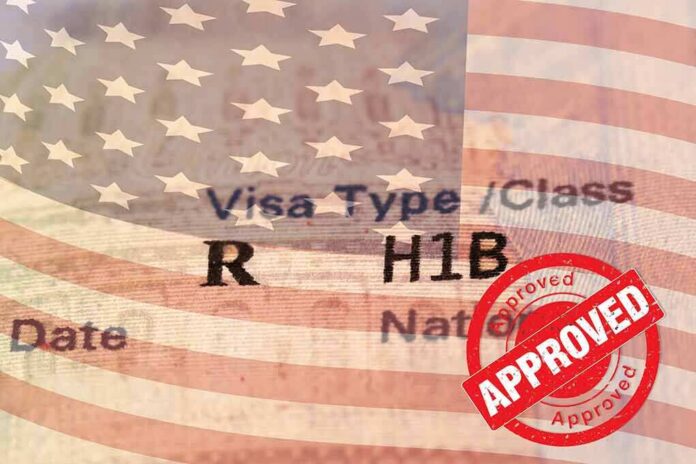
A federal judge struck down President Trump’s $100,000 H-1B visa fee as unlawful, but his administration is now moving to lock a similar six-figure charge into regulation.
Story Snapshot
- A court vacated the $100,000 H-1B fee as an unauthorized tax.
- The administration proposed a new rule to set a $103,265 fee for new H-1B filings.
- The original 2025 proclamation cited presidential entry powers and offered narrow exceptions.
- Hospitals, schools, and faith groups warned of workforce gaps if the fee returns.
What Changed: Court Ruling Collides With New Fee Proposal
On June 8, 2026, a federal judge ruled that the $100,000 payment tied to new H-1B visas was an unlawful tax that Congress never authorized, and vacated the requirement in full. The decision undercut a 2025 presidential proclamation that had conditioned the entry of specialty-occupation workers on proof of a six-figure payment. On August 24, 2026, the administration released a proposed regulation to reestablish a similar fee at $103,265 for new petitions, opening a fresh legal and policy fight.
The 2025 order had leaned on sections 212(f) and 215(a) of the Immigration and Nationality Act to restrict entry of certain nonimmigrant workers, including H-1B applicants, and created a limited national-interest exception process. The court found those entry powers do not include authority to levy a broad payment condition that functions like a tax. The new rule aims to place the charge in the regulatory code, which would change the legal posture, but it will still face challenges over statutory limits and economic impact.
How The Original Policy Worked And Who It Hit
The proclamation took effect in September 2025 and required U.S. employers to submit payment proof with any new H-1B petition after the effective date. It applied to the 2026 lottery and other new filings, with narrow exceptions for defined national-interest cases. The administration framed the policy as a worker protection measure to curb program abuse and alleged displacement of U.S. workers. Employers, universities, and nonprofits argued the abrupt cost burden stalled hiring and cut off needed talent pipelines.
Advocacy groups and affected employers filed suit, saying the fee sparked chaos, forced sudden travel changes for workers, and led firms to pause or cancel recruiting. They warned of harm to hospitals, schools, and churches that depend on H-1B professionals in hard-to-staff roles, especially in rural areas. These claims stressed real-world effects on patient care, classroom staffing, and community services. The court ruling removed the immediate payment barrier, but the proposed rule suggests those pressures could return if finalized.
Worker Protection Vs. Talent Supply: The Bigger Fight
The H-1B debate sits at the crossroads of labor markets and immigration control. Supporters of tighter rules say limits are needed to stop wage undercutting and offshoring. Critics say high fees choke off essential skills and risk moving jobs and research abroad. Congress’s own research shows mixed evidence. Some studies link more approved H-1B petitions to gains in certain foreign-born employment, while others find offsetting reductions elsewhere, often among non-U.S.-born workers. This split helps explain why the fight keeps returning.
Both parties say they want fair pay and strong innovation, yet the tools they back differ. Large, across-the-board fees are blunt instruments. They can block abuse, but they also hit hospitals, schools, startups, and small towns that cannot absorb sudden costs. When policies swing hard, communities feel whiplash. People on the right see a system that ignored worker pain for years. People on the left see elites writing rules that wall off opportunity. Many now agree the process too often serves insiders, not citizens.
What To Watch Next: Legal Risks, Carve-Outs, And Local Impact
The proposed $103,265 fee must clear public comment and survive court review. Judges will test whether agencies have clear authority to set a fee of that size and purpose, after a court called the earlier version a tax beyond presidential power. Watch if the final rule narrows who pays, creates broader hardship waivers, or phases in costs to avoid shock to employers and communities. Any carve-outs for healthcare, education, or rural areas could ease pressure but complicate enforcement.
President Trump's New Order on H-1B Visas Sends Shockwaves Through Immigrant Communities | Becca Lower, RedState
The Trump administration is widening its crackdown on the H-1B system, targeting two major benefits tied to the program: work permits for certain visa holders’… pic.twitter.com/7SZFNwZNOA
— Owen Gregorian (@OwenGregorian) August 30, 2026
Local leaders will track hiring delays, unfilled roles, and service cutbacks if a new fee lands. Employers will weigh shifting projects overseas to find needed skills. Taxpayers will ask whether high charges fix real problems or just raise barriers while insiders adapt. The core test is simple: Does the policy protect U.S. workers without starving hospitals, classrooms, labs, and small towns of talent? Clear goals, honest data, and guardrails against capture are the only way to earn public trust.
Sources:
redstate.com, employmentlawworldview.com, natlawreview.com, pbs.org, reuters.com, bloomberg.com