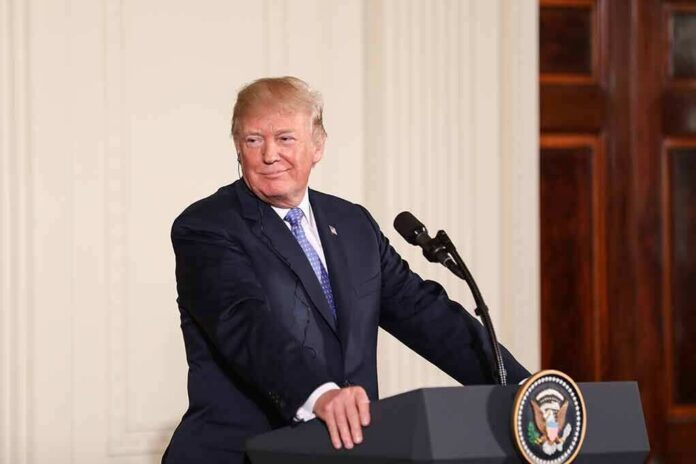
President Trump used the rescheduled White House Correspondents’ Dinner to joke about a third term, and the room heard it plainly.
Quick Take
- Trump told the dinner crowd that “the third time will be better yet,” then said he was “only kidding.”
- He made the remark at a high-profile event that drew broad attention from major outlets.
- The Constitution still says no person can be elected president more than twice.
- Legal reporting says there is no clear lawful path for a third Trump term without a constitutional change.
What Trump Said at the Dinner
Trump addressed the rescheduled dinner after the original event was delayed by a shooting. Associated Press video coverage and other reports say he joked that “the second time is always better” and “the third time will be better yet,” which drew applause from the room. He later said he was only kidding and kept the line in a broader speech aimed at the press.
The moment mattered because it was not a private aside. It came in a public, televised setting where Trump used humor, insult, and showmanship to steer attention back to himself. Coverage from The Washington Times and other outlets says he later put on a “Trump 2028” hat, which kept the third-term theme in view even after he joked about it.
Why the Remark Drew Fast Attention
Trump has repeated third-term talk before, and that pattern made the dinner comment more than a one-off line. ABC News reported that he has said he is “not joking” about possibly seeking another term, while Reuters and TIME described him as keeping the issue alive with repeated teasing. That gives supporters a talking point and gives critics another reason to say he is testing the limits of the system.
At the same time, the legal line is not close. The Twenty-Second Amendment says no person shall be elected president more than twice, and multiple legal outlets say that plain text blocks a third Trump campaign unless the Constitution changes. Reuters quoted scholars saying the Constitution clearly limits presidents to two terms, while PolitiFact and Northeastern reported the same basic point.
The Legal Wall Around a Third Term
The strongest obstacle is simple language, not politics. The Constitution Center reproduces the amendment’s text, and it leaves little room for a normal third run. Reuters also noted that Trump did not explain any workable constitutional method for getting around the two-term rule. That matters because legal theories only go so far when the governing text is this direct.
A Note to Nigerians Over Trump's "Third Term"
Social media has been buzzing with claims that Donald Trump is planning to run for a third term, leading many to celebrate.
However, a quick fact-check is needed, it was merely a joke, not an official policy or announcement.… pic.twitter.com/X6B3ONwqTy
— Georgeow (@Armaniofitsia_G) July 25, 2026
Some commentators have floated a narrow loophole theory, but that view remains disputed and has not become settled law. FactCheck.org reported one professor’s argument that the amendment bars being elected again, but may not bar serving again through some other route. Other legal experts reject that reading, and the available reporting does not show a filed plan, court-tested strategy, or constitutional amendment campaign that would make the idea real.
What This Means Politically
The episode shows how quickly a joke can turn into a serious test of public trust. Trump’s allies can treat the line as banter or bravado, but opponents will hear a warning sign about where he wants the conversation to go. In a country already split over institutions, term limits, and executive power, even a joke about staying longer in office feeds the wider fight over whether the rules still bind powerful people.
That is why the story landed so fast. The dinner line was funny to some, troubling to others, and legally unresolved only in the sense that no court has been asked to rule on a real third-term bid. For now, the public record points in one direction: Trump keeps raising the idea, while the Constitution and most legal experts keep closing the door.
Sources:
youtube.com, lmulawreview.scholasticahq.com, bbc.com, factcheck.org, lyldenlawnews.com, reuters.com, abcnews.com, usatoday.com, politifact.com, news.northeastern.edu, nytimes.com, time.com