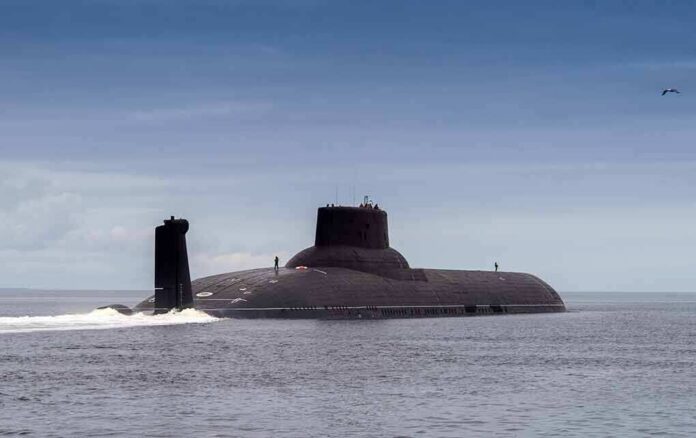
The U.S. military destroyed at least one of Iran’s three Russian-built Kilo-class submarines, dealing a major blow to Tehran’s aging undersea fleet.
Quick Take
- Iran commissioned three Russian-built Kilo-class submarines between 1992 and 1996, known in Iran as the Tareq class and nicknamed “Black Hole” because of their low acoustic signature.
- At least one of the three submarines has been destroyed, with reporting identifying the loss at Bandar Abbas.
- The submarines can carry torpedoes and mines but face major operating limits in the shallow Persian Gulf.
- The status of Iran’s remaining Kilo-class submarines is less clear, making the loss of one boat particularly significant.
Iran’s Aging Undersea Fleet
Iran commissioned three Russian-built Kilo-class submarines between 1992 and 1996. Known domestically as the Tareq class, they are Iran’s largest ocean-going submarines and have been based at Bandar Abbas. The boats, known inside Iran as the Tareq class, are the largest and most advanced vessels in the Iranian Navy. The boats are roughly 73 meters long and displace about 3,000 tons submerged.
The Kilo class earned the nickname “Black Hole” because of its unusually quiet acoustic signature, making the design difficult to detect under the right conditions. Each submarine has six torpedo tubes and can carry up to 18 torpedoes or, in a mine-laying configuration, up to 24 mines.
At Least One Kilo-Class Submarine Destroyed
At least one of Iran’s three Kilo-class submarines has been destroyed at Bandar Abbas, according to recent reporting and imagery of the damaged vessel. The loss reduces Iran’s already small force of large ocean-going submarines, which can operate beyond the shallowest parts of the Persian Gulf and into the Gulf of Oman and Arabian Sea.
The available reporting confirms the loss of at least one Kilo-class boat, but the operational status of Iran’s other two submarines remains less certain. The loss matters because Iran began the conflict with only three Kilo-class submarines, and open-source assessments have long described their availability as limited.
A Gulf Too Shallow For Full Advantage
Even before the strike, Iran’s submarines faced sharp limits. The Nuclear Threat Initiative says the Kilo-class boats require at least 164 feet of water, limiting them to roughly one-third of the Persian Gulf. The boats are better suited to deeper waters in the Gulf of Oman and Arabian Sea. Those depth restrictions make deeper waters near and beyond the Strait of Hormuz more useful for the boats than much of the Persian Gulf. Their home base is Bandar Abbas.
Why Analysts Still Watched Them Closely
The loss does not eliminate Iran’s submarine capability. Tehran also operates smaller Ghadir-class and other submarines designed for shallow-water operations, where the larger Kilo boats face significant limitations. But losing one of only three Kilo-class submarines is still a significant blow to Iran’s force of large, ocean-going diesel-electric boats. The remaining vessels can operate beyond the shallowest parts of the Persian Gulf and into the Gulf of Oman and Arabian Sea, giving Iran options that its smaller submarines do not fully replicate.
The loss also comes as Washington and Tehran remain locked in a broader confrontation over access to the Strait of Hormuz, where disruptions can affect global energy markets and commercial shipping
Sources:
globalsecurity.org, strausscenter.org, youtube.com, euronews.com, nationalsecurityjournal.org