
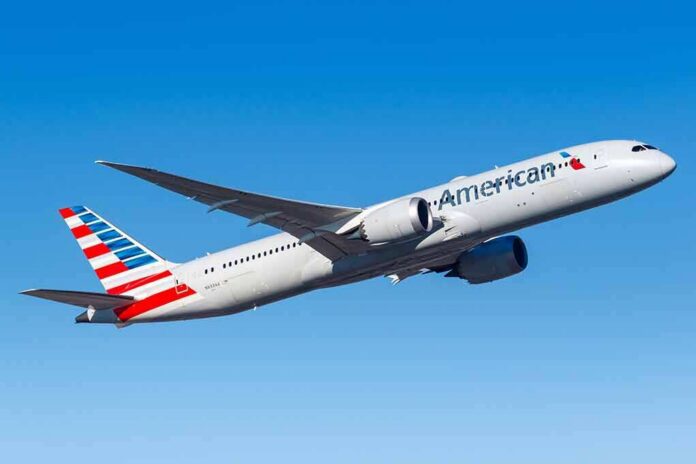
Passengers and crew stopped a man who tried to manipulate a door on an American Airlines flight, forcing a diversion to Phoenix, and raising fresh questions about safety and trust in the system.
Story Snapshot
- Phoenix police say the man moved to the front of the plane and tried to manipulate a door.
- Crew and passengers restrained him until the plane landed safely in Phoenix.
- Witness accounts describe the man trying multiple doors and shouting to get off the plane.
- Officials have not called it a hijacking or “takeover,” and the probe is ongoing.
What Happened On Flight 1494
Phoenix police said American Airlines Flight 1494 from San Diego to Chicago diverted to Phoenix after a passenger left his seat, walked to the front, ignored crew orders, and attempted to manipulate an aircraft door. Video shared with reporters shows several people holding the man near the forward galley as the plane continued to Phoenix. Police said crew members and passengers restrained the man until landing. The aircraft landed safely, and officers met the plane at the gate.
Passengers gave similar reports after landing. One traveler said the man tried both a side door and the main door while shouting, “I want to see Jesus. Get me off this plane”. A local report said another passenger placed himself between the man and the area by the cockpit to block him. These accounts match the police description of movement toward the front and door tampering. They also explain why the crew chose to divert the flight.
What Officials Say It Was—And Was Not
The police language matters. Phoenix police used the phrase “attempted to manipulate an aircraft door.” They did not say the door opened, that the cockpit was breached, or that control of the plane was ever at risk. Some early posts and headlines claimed a cockpit attempt or a “takeover,” but later reports tied the conduct to a forward cabin door instead. Based on public statements, officials are treating this as an unruly-passenger event, not an attempted hijacking.
That distinction fits larger patterns. The Federal Aviation Administration (FAA) tracks hundreds of unruly-passenger cases each year. The rate is far below the 2021 peak but still high by historic standards. Airlines had reported more than 1,500 such incidents by late 2026, and many lead to diversions like this one. These events strain crews, delay travelers, and trigger costly responses on the ground. Most never involve a credible chance of seizing an aircraft.
Why This Keeps Happening
Air travel brings tight spaces, stress, and delays. Add alcohol, mental health struggles, or anger at rules, and small problems can turn into real safety risks. FAA “zero tolerance” messaging and higher fines helped drive down cases since 2021, but the problem has not gone away. Crew members train to de‑escalate, call for help, and, when needed, restrain a person to protect the cabin. On Flight 1494, that training combined with quick action by nearby passengers.
Many readers on the right and left see a deeper issue. They feel leaders talk tough but do not fix basics. People expect safe flights, clear rules, and steady enforcement. When a man can walk to the front of a plane and try a door, that trust takes a hit. The good news is the system worked this time: the crew reacted, fellow travelers stepped up, and police met the plane. The open question is whether policy will keep up with the risk, not only punish it after the fact.
What We Still Do Not Know
Officials have not released a charging document. The Federal Bureau of Investigation (FBI) interviews and any U.S. Attorney decision were still pending in the reports we have. We also do not have the full incident report, body-camera video, or cockpit-to-ground audio. Those records would show which door was touched, what words were used, and how close the man came to any secure area. For now, the hard fact is attempted door manipulation, restraint on board, and a safe diversion.
What Matters For Travelers
Crews need fast compliance when they give instructions. Federal rules back them up, and fines can be steep. If you see a threat, call a flight attendant at once. Do not rush in unless asked or unless there is clear danger. If you are seated in exit rows, review the card and listen closely. Doors on modern jets are designed not to open at cruising altitude, but attempts can still spark panic, injuries, or damage. Calm action beats viral chaos every time.
The Bigger Takeaway
This incident shows both the risk and the remedy. One person can cause fear and force an emergency stop. Yet a trained crew, alert passengers, and a firm response kept everyone safe. That is not luck. It is the system doing its job. The next step is accountability that matches the facts, better screening for warning signs, and steady support for front-line workers. People deserve flights where safety comes first and politics stays off the plane.
Sources:
thegatewaypundit.com, azfamily.com, paddleyourownkanoo.com, abc7.com, wvlt.tv, yahoo.com, local.newsbreak.com