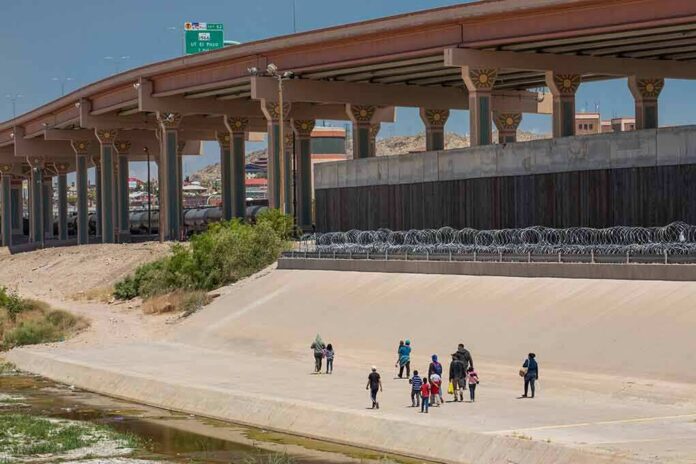
Cartels are quietly turning El Paso’s storm drains into an underground highway, while politicians above ground keep arguing and most Americans are left wondering who, if anyone, is really in control.
Story Snapshot
- Cartels are using El Paso’s vast storm drain system and hidden tunnels to move migrants and drugs under a major American city.
- Border agents say there are dozens of river entry points and hundreds of exits in town, turning enforcement into a “whack-a-mole” struggle.
- A recently discovered, high-tech tunnel links Ciudad Juarez directly into an El Paso storm drain and shows serious planning and money.
- These cases expose how well-funded criminal networks exploit public infrastructure while Washington focuses on speeches, not solutions.
Underground routes beneath a major American city
Border Patrol agents and local reporters say El Paso sits on top of a huge storm drain maze that cartels now use as a hidden route into the United States. The system runs for hundreds of miles under streets, highways, and neighborhoods, with many openings near the Rio Grande and inside the city itself. Agents describe it as a place where a few guides can move small groups of migrants, slipping past cameras and fences that focus only on above-ground crossings. For people worried about border chaos, this feels like the system literally going under the radar.
Fox News correspondent Brooke Taylor was given rare access inside these drains alongside the Border Patrol’s Confined Space Entry Team, a specialized unit trained to work in tight, dangerous tunnels. Her footage shows cramped, dark passages where heat, chemicals, and low oxygen turn each trip into a serious risk, not only for migrants but also for the agents chasing them. Cartels charge migrants tens of thousands of dollars for this “VIP” underground route, turning public infrastructure into a private profit stream for organized crime.
A sophisticated tunnel built into the storm drain system
Homeland Security Investigations in El Paso and Border Patrol recently found a man-made tunnel that begins in Ciudad Juarez and cuts under the border wall into the Boone Street storm drain on the Texas side. Investigators say the passage is about four feet wide and six feet high, big enough for an adult to walk upright. It is reinforced with wooden beams and fitted with electric lights and a ventilation system, making it far more than a simple hole in the ground. Officials believe it was built within the year before discovery, showing a recent and active effort.
Mexican and American authorities say this tunnel sits inside a storm sewer network that smugglers treat as a prime route for high-paying customers. Reports describe it as part of a “VIP package” for migrants who can afford five-figure fees to avoid crowded crossings and patrols. The fact that cartels invested one to two years of labor, materials, and planning into a single underground link should worry anyone who thinks the border can be fixed with slogans alone. It shows rich criminal groups adapting faster than the public agencies meant to stop them.
Concrete cases, real people, and a deadly business
This underground story is not only about tunnels and maps; it is about actual people caught inside the system. In January, Border Patrol agents responding to reports near the Boone Storm Drain found a manhole entry and high chlorine levels, then tracked 69 migrants moving through El Paso’s public storm drains. They arrested adults and teens from several Latin American countries, including unaccompanied children from Mexico and Guatemala, all pushed into a toxic maze by smugglers chasing cash.
Federal court records show that some tunnel guides and organizers tied to cartel-linked smuggling have been sentenced to prison in El Paso after deadly incidents. One case involved a migrant left to die following a heart attack during a smuggling attempt, while others dealt with separate tunnel operations run by local partners of larger criminal groups. These prosecutions confirm that underground routes are not just rumors or TV visuals; judges, prosecutors, and families are dealing with the human cost in real time.
What this reveals about government, cartels, and ordinary Americans
Border Patrol officials admit they know of many storm drain entry and exit points but cannot seal or guard them all because the system is needed for flood control and basic city safety. One interim chief said El Paso has over 100 access points, and agents describe enforcement in this maze as a constant “whack-a-mole” challenge. While Washington argues over walls, budgets, and talking points, cartels quietly study public engineering diagrams and find the gaps that no press conference can close.
𝐂𝐀𝐑𝐓𝐄𝐋𝐒 𝐀𝐑𝐄 𝐒𝐌𝐔𝐆𝐆𝐋𝐈𝐍𝐆 𝐌𝐈𝐆𝐑𝐀𝐍𝐓𝐒 𝐓𝐇𝐑𝐎𝐔𝐆𝐇 𝐌𝐈𝐋𝐄𝐒 𝐎𝐅 𝐒𝐓𝐎𝐑𝐌 𝐃𝐑𝐀𝐈𝐍𝐒 𝐔𝐍𝐃𝐄𝐑 𝐄𝐋 𝐏𝐀𝐒𝐎, 𝐂𝐇𝐀𝐑𝐆𝐈𝐍𝐆 𝐔𝐏 𝐓𝐎 $𝟑𝟎,𝟎𝟎𝟎 𝐀 𝐇𝐄𝐀𝐃
Fox News got rare access underground with Border Patrol’s elite confined space entry… pic.twitter.com/FEYH0hAOLW
— M.A. Rothman (@MichaelARothman) July 17, 2026
For many Americans on both the right and the left, this story feeds a growing belief that powerful interests run circles around a slow, divided government. Conservatives see criminal groups exploiting weak enforcement even as they hear claims that the border is “secure.” Liberals see desperate migrants risking death underground because legal routes remain tangled and slow. Both sides can agree on one hard fact: when cartels are building lit, ventilated tunnels under a major city, something in the system is deeply broken.
Sources:
youtube.com, nypost.com, elpasotimes.com, foxnews.com, justice.gov, 2ndlifemediaalamogordo.town.news, instagram.com, facebook.com