

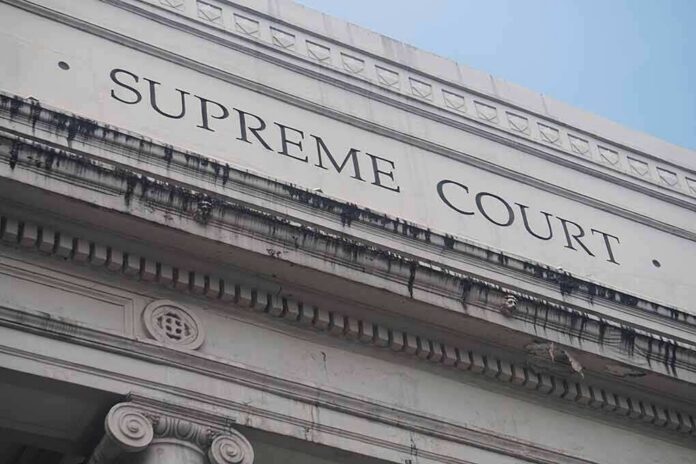
Justice Samuel Alito warned that Congress holds the power to “turn off the lights” at the Supreme Court by cutting its funding — a stark reminder that one branch can choke another without changing a single law.
Story Snapshot
- Alito said Congress could halt Supreme Court operations by withholding money, citing the Court’s lack of a “purse.”
- Democratic leaders continue to push reforms like court expansion, term limits, and enforceable ethics rules.
- Public trust in the judiciary is low, fueling louder calls for structural changes.
- Ethics controversies around some justices give reformers more leverage in the debate.
Alito’s Warning About Congressional Power Over Court Operations
Justice Samuel Alito recently warned that Congress could “turn off the lights” at the Supreme Court by defunding its daily operations. He grounded the point in the Constitution’s design, which gives Congress control over the “purse,” while judges lack money and force. He linked this leverage to broader political pressure aimed at changing the Court’s direction. Reporting described his concern that sustained pressure could “fundamentally” and perhaps permanently change the Court’s role. He did not cite a specific bill to cut the Court’s budget.
Alito’s comments echo a long-running civics lesson. Congress sets budgets. The judiciary must rely on those appropriations to pay staff, secure the building, run technology, and hear cases. Article III protects life tenure and bars pay cuts for judges, but it does not fund the courts on autopilot. That design preserves checks and balances. It also leaves room for abuse if elected leaders decide to squeeze the Court for political gains. Alito framed his warning within that tension.
Democratic Reform Push: Expansion, Term Limits, and Ethics Rules
Democratic lawmakers and candidates continue to press a wide package of reforms. Proposals include increasing the number of justices from nine to thirteen, setting eighteen-year active terms with rotation to lower courts afterward, and creating an enforceable ethics code with real investigations and gift limits. Supporters say these steps would add predictability, lower temperature, and restore public trust in decisions. These ideas are on paper in bills and public statements, not only as talking points.
Representative Adam Schiff has argued that term limits can be designed to fit the Constitution. His model would move a justice to a lower court after eighteen years while keeping life tenure. He also backs an enforceable ethics code and court expansion, saying the system needs guardrails after years of partisan fights over nominations. Schiff frames these moves as accountability and stability, not an attempt to “destroy” the Court or make it a political arm of one party.
Low Trust and Ethical Controversies Shape Public Mood
Declining trust in the judiciary sets the backdrop for this clash. Reporting has described weak confidence numbers and rising frustration with how the Court handles big cases and emergency orders. In that climate, reformers claim a mandate to act. They argue that stable terms, more transparent ethics, and clear recusal rules would cool the temperature and refocus the Court on law, not politics. Skeptics fear the cure could be worse than the disease if Congress overreaches.
Ethics stories involving justices have intensified the push. ProPublica reported that Justice Alito took a 2008 private-jet trip with hedge fund manager Paul Singer and did not disclose it at the time. Alito denied wrongdoing and said the rules did not require disclosure. Critics point to such reports as proof that the Court needs outside enforcement, not voluntary guidelines. That argument resonates with voters who see one set of rules for elites and another for everyone else.
What Is Established, What Is Not, and Why It Matters
Alito’s point about funding is structurally sound: Congress controls court appropriations. His larger warning is predictive. The research does not identify a live appropriations bid to zero out the Court’s budget. The current reform energy on the Democratic side centers on expansion, ethics enforcement, and term limits, supported by public statements and reported legislation. The stakes are high because well-meaning reforms can still change how independent a court feels and functions.
“The least powerful branch”: Samuel Alito says the Supreme Court “will be fundamentally changed” if its independence is undermined #U.S.SupremeCourt #SamuelAlito #Washington,D.C. #Legislature #Courtcaseshttps://t.co/6T4gMMfwwk
Democrats attack everybody including SCOTUS,!?— MWB (@Mb51082451) November 21, 2026
For citizens across the spectrum, the through-line is simple and urgent. When one branch can freeze another by turning a budget dial, power can shift fast. When ethics rules feel loose, trust melts and people assume the game is rigged. Both concerns are real. The challenge is to draw a clear line between fair oversight and political punishment. That line should protect independence, demand transparency, and keep the people — not the insiders — at the center of the system.
Sources:
pjmedia.com, nytimes.com, inquirer.com, talkingpointsmemo.com, news.bgov.com