
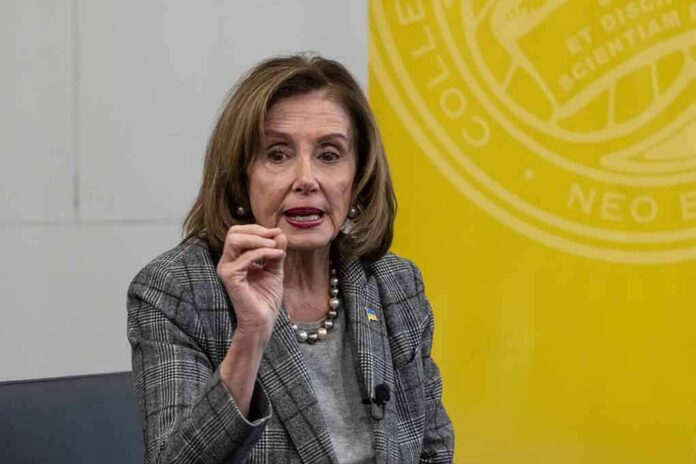
Nancy Pelosi’s on-air rebuke of Abdul El-Sayed’s Israel stance cracked open a late-campaign rift Democrats could not hide.
Story Highlights
- Pelosi said El-Sayed’s Israel position is “wrong” and not representative of congressional Democrats.
- An outside group’s ad tying grocery prices to U.S. aid for Israel sparked backlash; El-Sayed disavowed it.
- Reports say El-Sayed has avoided affirming Israel’s right to exist as a Jewish state while stressing equal rights.
- The dispute underscores deeper Democratic divides on Israel policy ahead of Election Day.
What Pelosi Said And Why It Matters
On October 30, former House Speaker Nancy Pelosi said Abdul El-Sayed’s stance on Israel was “more than concerning. It’s wrong,” and “isn’t a reflection of the Democrats in the Congress of the United States.” The exchange came on a podcast after the host framed El-Sayed’s view as denying Israel’s right to be a Jewish state. Pelosi’s office later said she still supports his candidacy on domestic issues, showing criticism of his view, not a total break.
Pelosi’s intervention landed days before voting, which raised the stakes. Her comments gave Republicans a sound bite and forced Democrats to answer tough questions in Michigan. Supporters saw her line as a defense of party norms. Critics saw it as elite policing of debate. Both sides agreed on the effect: it spotlighted a real split inside the party over how to talk about Israel and Palestinian rights in 2026.
The Ad Controversy That Fueled The Fire
Rebellion PAC, an outside group, ran an ad suggesting families must set aside money “for killing Palestinians,” linking grocery prices to U.S. aid for Israel. Jewish organizations called it antisemitic. El-Sayed’s campaign said the ad was not affiliated and did not speak for him, an effort to wall off the message from his platform. The outside sponsorship matters because federal law bars direct coordination, yet voters often blur those lines.
Coverage detailed how the ad’s framing let opponents tie kitchen-table pain to a foreign ally, a charge many found offensive and dangerous. The blowback pressured El-Sayed to distance himself fast and clearly, which he did. But the timing meant the ad still shaped late narratives around his run. The sequence also strengthened Pelosi’s case that the political climate around the race had crossed a line for many Democrats.
Where El-Sayed Actually Stands
Reports and prior interviews show El-Sayed focuses on equal rights and self-determination for Palestinians and Jewish Israelis. He has criticized Israeli policies as apartheid in the West Bank and called actions in Gaza genocide. He has argued U.S. aid enables leaders who oppose a two-state solution. He has also declined to give a simple yes to Israel’s right to exist as a Jewish state, saying the question ignores Palestinian rights and the lack of a Palestinian state.
Analysts note this places him in a smaller Democratic faction that opposes military aid and uses harsh rights-based language. A larger group seeks conditions on aid without using those labels. Establishment Democrats defend the alliance while pressing Israel on policy. That spectrum explains Pelosi’s claim that El-Sayed’s view is not representative of congressional Democrats, even as many voters have shifted toward stronger criticism of Israeli policies.
Why Both Left And Right See A System Problem
Voters on the right see the ad as proof that activist elites will scapegoat allies and inflame division, while dodging inflation and energy policy. Voters on the left see party leaders silencing dissent on foreign policy while failing to deliver lower costs at home. Both camps distrust the money system that let an outside group hijack a race’s message days before voting, deepening the sense that insiders, not citizens, call the shots.
The episode shows how modern campaigns reward heat over light. An unaffiliated ad can dominate attention more than policy plans. A single quote can define a candidate more than months of town halls. Pelosi’s rebuke tried to draw a boundary without sinking a nominee. Instead, it revealed how fragile party lines are when outside money, global conflict, and kitchen-table stress collide right before Election Day.
The Bottom Line For Michigan Voters
Michigan voters face two truths at once. First, Pelosi clearly rejected a view she saw as out of bounds for Democrats in Congress. Second, El-Sayed says he backs equal rights and rejects the framing that centers only Israel’s identity while ignoring Palestinians. The record does not show him authorizing the ad that sparked outrage. It does show a party still arguing over how to balance alliance, security, rights, and costs at home.
Sources:
twitchy.com, fortune.com, nytimes.com, thejewishnews.com