
As Donald Trump’s second term powers ahead under full Republican control, Senate Democrats are quietly building a legal and political machine to challenge his power and finances long after he leaves office.
Story Snapshot
- Chuck Schumer is leading Senate Democrats in a multi-front plan to hold Trump accountable through oversight, lawsuits, and new laws.
- Democrats have launched a whistleblower portal and “spotlight” hearings to surface alleged corruption and abuses inside the Trump administration.
- Schumer now wants to rewrite immunity rules so Trump can be prosecuted for efforts to overturn the 2020 election.
- Both parties see the fight as proof that powerful elites bend the rules, deepening public distrust of the federal government.
Schumer’s Pledge To Keep Trump Accountable
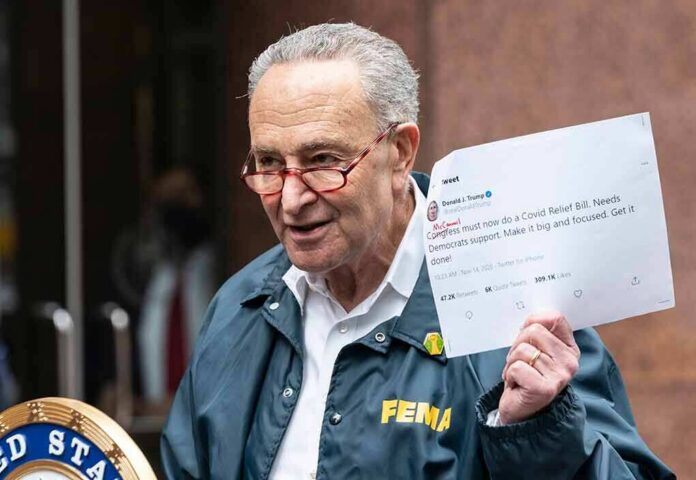
Senate Democratic Leader Chuck Schumer has promised for years that his caucus will hold Donald Trump and the Republican majority “accountable” for their actions in office. He made that vow when he first took over Democratic leadership, saying their job was to keep Trump’s “feet to the fire” rather than simply oppose him on talking points. That message has only sharpened in Trump’s second term, as Schumer ties accountability to costs for working families, alleged corruption, and what he calls assaults on basic democratic checks and balances. For many Americans on both the right and left, this language taps into a shared fear that those in power can break rules without consequences while regular citizens struggle just to keep up.
In a detailed “Dear Colleague” letter, Schumer laid out how Senate Democrats plan to confront what he calls the Trump administration’s “assault on American families.” He described a four-part strategy built on oversight, litigation, legislation, and broad public communication. Oversight means using committees to send hundreds of inquiries into Trump policies and decisions, probing both the legal basis and the real impact on everyday people. Litigation means backing lawsuits from states and public interest groups, and filing court briefs to challenge executive actions they say cross legal lines. In short, Schumer is telling fellow Democrats to treat Trump not only as a political opponent, but as a target for structured investigations that could outlast his time in the White House.
New Tools: Whistleblower Portal And “Spotlight” Hearings
To feed those investigations, Schumer helped launch a new whistleblower portal for federal workers who see possible corruption, abuse of power, or threats to public safety inside the Trump administration. He and Senator Gary Peters wrote to civil service employees urging them to report problems through this secure channel, promising support for “brave whistleblowers” who step forward. Senate Democrats also plan independent “spotlight” hearings, even when Republicans refuse to hold official ones. These sessions would feature witnesses, documents, and testimony about alleged wrongdoing, putting what they see as harmful Trump policies under a public microscope. To many Americans already worried about a “deep state” and shadow deals, the idea of insiders exposing what happens behind closed doors is both hopeful and unsettling.
Beyond hearings, Schumer’s plan calls for demand letters to agencies, efforts to preserve public records, and legal action “when necessary” to protect democratic norms. He and House Democratic leaders have described a four-step “recourse” plan: highlight harmful actions, sue when those actions seem unlawful, dig in with oversight, and push legislation to block future abuses. For conservatives frustrated with past liberal overreach, this looks like Democrats using every tool to hobble a president they dislike. For liberals angry about “America First” moves, it reads as overdue resistance to a leader they view as unchecked. Underneath both reactions sits a larger worry: if only insiders, lawyers, and party leaders can police presidents, where does that leave ordinary citizens?
Taking On Trump’s Immunity And War Powers
Schumer’s latest move goes beyond Trump’s current term and into his legal future. After the Supreme Court ruled that presidents have strong immunity from prosecution for “official acts,” Schumer vowed to introduce a bill that would classify Trump’s efforts to overturn the 2020 election as “unofficial” actions. The goal is simple: make sure those acts do not enjoy the shield the Court just granted. He argues that Congress has power under Article I of the Constitution to define what counts as official conduct and to guard against judicial overreach. Supporters say this is about restoring basic fairness; critics see it as Congress rewriting laws to target one man.
Schumer has also used war powers fights to press his accountability message. In past clashes over Venezuela and Iran, he backed resolutions to block Trump from using the United States Armed Forces in hostilities without explicit approval from Congress. He framed these votes as a way to stop “reckless” military moves and force clearer public answers on casualties and strategy. These battles fit a long pattern where lawmakers accuse presidents of hiding information or stretching war powers, and presidents answer that they need freedom to act quickly. For citizens, the picture can look the same either way: powerful people make life-and-death decisions far from public view, and arguments over legality often feel like they come after the fact.
Shared Distrust In A System Of Elites
Schumer’s accountability push speaks to broader concerns about corruption in the presidency. Historians and ethics experts have described the Trump years as a time when the line between public duty and private gain grew especially blurry, with thousands of possible conflicts of interest tied to Trump businesses while he held office. At the same time, Trump and his allies have blasted many investigations as “nonsense” and “games,” saying they are driven by politics, not facts. No court has yet issued a sweeping ruling on every allegation Democrats make, so much of this struggle plays out in press conferences, letters, and reports rather than in final legal judgments.
For older conservatives who already feel burned by globalism, rising costs, and woke agendas, Schumer’s moves may look like one more attempt by liberal elites to overturn elections they do not like. For older liberals upset about tax cuts for the rich, immigration raids, and fossil fuel expansion, they may look like one of the few serious efforts to check a president they see as breaking basic rules. But on both sides, more and more Americans share one core belief: the federal government answers first to itself, not to them. Whether they view Schumer as a needed watchdog or a partisan warrior, his campaign to “follow the money” around Trump highlights how deep the crisis of trust now runs.
Sources:
youtube.com, democrats.senate.gov, thehill.com, cbsnews.com, facebook.com, murphy.senate.gov, reuters.com, whitehouse.senate.gov, americanheritage.com, nbcnews.com