President Trump is drawing a hard line with NATO allies, warning the alliance faces a “very bad future” if member nations refuse to send warships to help reopen the Strait of Hormuz—a critical oil chokepoint Iran has blockaded amid escalating military conflict.
Story Snapshot
- Trump demands NATO allies deploy warships to help secure the Strait of Hormuz after Iran closed the critical waterway handling 20% of global oil supply
- US forces struck approximately 90 Iranian military targets on Kharg Island while deliberately sparing oil infrastructure as negotiation leverage
- Oil prices have surged over 40% since Iran declared the strait closed on March 4, 2026, attacking ships attempting passage
- Iran’s new Supreme Leader Mojtaba Khamenei vows to maintain the closure while rejecting diplomatic talks with the United States
- Trump warns that allies refusing to participate risk NATO’s viability while preparing US Navy escorts for commercial tankers
Trump Pressures International Coalition for Naval Support
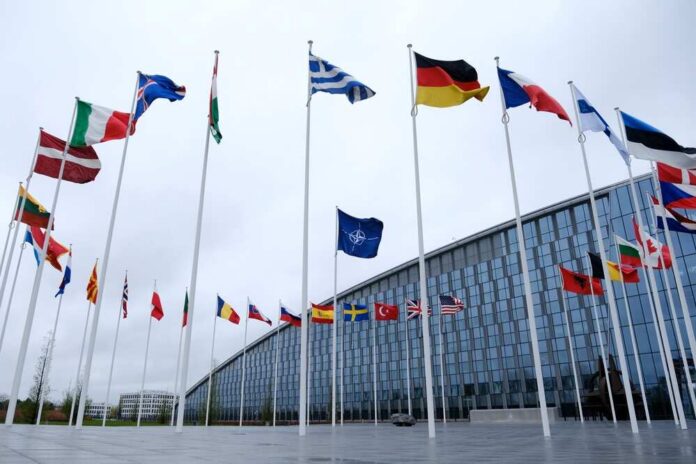
President Trump publicly called on multiple nations to deploy naval forces to the Strait of Hormuz, specifically naming NATO members including the United Kingdom and France, along with China, Japan, and South Korea. Trump’s March 14 Truth Social post emphasized that “many countries” should send warships to address Iran’s blockade of the vital waterway. The President directly linked allied participation to NATO’s future, stating the alliance faces dire consequences if members fail to contribute. Trump’s coercive diplomacy represents an unprecedented tying of NATO’s viability to participation in a Middle East military operation outside the alliance’s traditional European focus.
US Strikes Target Iranian Military While Sparing Oil Infrastructure
US Central Command executed large-scale precision strikes on March 13-14 against Kharg Island, Iran’s primary oil export hub located 20 miles off the Iranian coast. The operation targeted approximately 90 military installations while deliberately avoiding oil infrastructure, which Trump described as leverage for future negotiations. The President stated US forces “totally obliterated” military targets on the island and continue bombing Iranian shoreline positions and patrol boats. This strategic restraint differs from total warfare approaches, preserving Iran’s economic capacity as a negotiating chip while degrading its military ability to enforce the strait closure. Analysts note this calculated approach aims to pressure Iran’s regime without completely destroying its revenue sources.
Iran Maintains Blockade Despite Economic Consequences
Iran declared the Strait of Hormuz closed on March 4, 2026, and has since attacked ships attempting passage through the 21-mile-wide chokepoint. Iran’s new Supreme Leader Mojtaba Khamenei, who assumed power following his father’s death, issued his first public statement upholding the closure as a “lever” against US and Israeli actions. Iranian Foreign Minister Abbas Araghchi rejected negotiations during a March 15 CBS “Face the Nation” appearance, stating Iran prioritizes diplomacy but refuses talks during active conflict. The Islamic Revolutionary Guard Corps has threatened additional attacks on regional ports, including ordering evacuations of three major UAE facilities—marking the first threats against civilian infrastructure in this conflict.
Global Energy Markets Face Unprecedented Disruption
The strait’s closure has triggered oil price increases exceeding 40%, creating worldwide economic shockwaves across energy, shipping, and aviation sectors. The waterway normally handles approximately 20% of global oil supplies, making its blockade one of the most significant energy disruptions in modern history. Unverified reports suggest Iran has mined the narrow passage, though US Navy capabilities to clear such obstacles remain limited by outdated minesweeping equipment. Security analysts predict US operations to fully secure the strait “will take weeks” even with allied support, prolonging market volatility. Major oil importers including China, Japan, and European nations face immediate supply pressures, while American consumers experience rising prices at the pump despite Trump’s predictions of eventual decreases.
Trump’s demand for allied naval participation reflects frustration with burden-sharing arrangements that have characterized his approach to international security alliances. The President’s warning that NATO faces a “very bad future” without participation echoes his longstanding criticism that European allies underpay for collective defense while expecting American military protection. This crisis tests whether NATO members will commit forces to secure global commerce outside the alliance’s traditional Article 5 mutual defense framework. Analysts note Iran is unlikely to back down soon, as both sides retain leverage—the US through military superiority and strikes, Iran through asymmetric control of the strategic chokepoint. Trump’s framing of allied participation as essential to NATO’s survival represents a high-stakes gambit that could reshape transatlantic security relationships regardless of the strait’s ultimate status.
Sources:
Council on Foreign Relations – Iran, the Strait of Hormuz, and an Unprecedented Energy Crunch
USNI News – Report to Congress on the Iran Conflict and Strait of Hormuz