

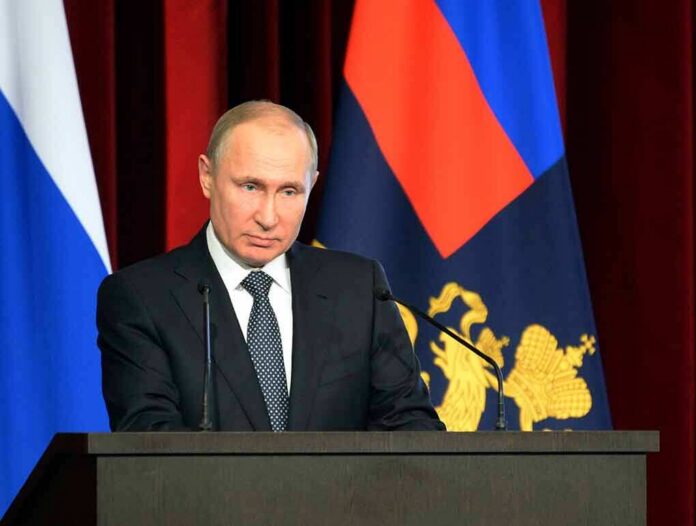
Russia freed American Stephen Hubbard during a meeting between U.S. envoy Steve Witkoff and President Vladimir Putin, turning high-stakes talks into a life-changing result for one citizen.
Story Snapshot
- U.S. envoy Steve Witkoff said Russia released American Stephen Hubbard during talks with Vladimir Putin.
- Putin said Hubbard was taken to Pulkovo Airport in St. Petersburg after his release.
- Hubbard, a 74-year-old Michigan native and retired teacher, had been detained since 2022.
- The U.S. State Department had designated Hubbard as wrongfully detained in 2025.
What Happened and Who Confirmed It
Steve Witkoff, the U.S. presidential envoy, met Vladimir Putin in Russia and said that Moscow released American citizen Stephen Hubbard during the visit. Russian reports aligned with that account, and Putin said authorities brought Hubbard to Pulkovo Airport in St. Petersburg after the handover. The timing linked the release to active diplomacy. Reports tied earlier White House outreach to the case, noting President Trump had raised Hubbard’s detention with Putin ahead of Witkoff’s travel.
Major outlets identified Hubbard as a 74-year-old retired teacher from Michigan and a U.S. citizen. Coverage described him as the last American in Russia that Washington had formally classified as wrongfully detained at the time, highlighting the case’s priority for U.S. officials. The public confirmations from Witkoff and statements attributed to Putin set the core facts: an American prisoner’s release, a meeting at the top level, and fast movement to an airport for onward transit.
The Detention, Trial, and U.S. Designation
Reports said Russian forces detained Hubbard in eastern Ukraine in April 2022 amid the wider war, then moved him through Russia’s justice system. Russian authorities later accused him of serving with a Ukrainian defense unit and, after a closed proceeding, a court convicted him in October 2024 and imposed a sentence of nearly seven years, summarized as six years and 10 months in some accounts. In January 2025, the U.S. State Department designated Hubbard as wrongfully detained, shifting his case into specialized channels.
That “wrongfully detained” status matters for process and resources. Under U.S. policy, the designation moves a case to the Office of the Special Presidential Envoy for Hostage Affairs, which coordinates across agencies to seek release when a foreign government treats a detention as leverage rather than standard criminal law. This approach reflects a broader U.S. trend to treat state-driven detentions differently from routine consular cases, enabling higher-level negotiations, targeted pressure, or swaps when appropriate.
Why This Fits a Bigger Pattern
Hubbard’s case fits a larger pattern of state actors detaining foreigners during tense periods and using them in broader talks. Reviews of recent years show that many Americans held abroad are classified as wrongfully detained or hostage cases, often by governments seeking advantage. Analysts and practitioners describe how these cases move from local courts to national bargaining tables, where envoys and presidents weigh options to bring citizens home while managing other strategic goals.
🇺🇸🇷🇺 Trump says holding off on new Russia sanctions helped FREE an American imprisoned by Moscow…
POTUS says critics who demanded immediate sanctions have since apologized, because they didn't know he was negotiating for Stephen Hubbard, the 74-year-old American designated as… pic.twitter.com/Y1B5oUk0ZQ
— The17thletter (@john_john017) October 21, 2026
This outcome will echo across U.S.-Russia relations and domestic politics. Supporters of hard bargaining will see proof that direct talks can free Americans. Critics of great-power deals will worry about incentives that encourage more detentions. For families, the policy debate is abstract; the outcome is concrete. An American in his seventies, long held overseas, is on his way home because senior leaders engaged and pushed the case to the top of the agenda.
Sources:
cbsnews.com, apnews.com, bostonglobe.com, cnn.com, bbc.com, foxnews.com, nytimes.com, steptoe.com