
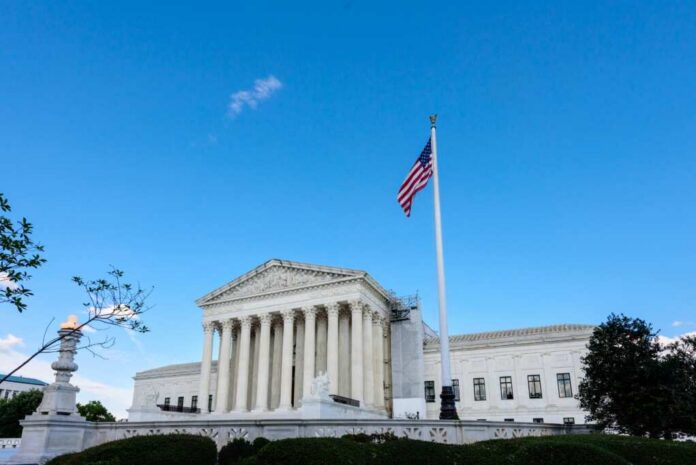
With the Supreme Court racing toward blockbuster rulings on birthright citizenship and election rules, the final weeks could redefine borders, ballots, and the balance of power for years to come.
Story Highlights
- The Supreme Court’s June 2025 order limited nationwide injunctions while letting parts of President Trump’s birthright policy proceed in non-suing states [2].
- The Court formally set a full review of the policy’s constitutionality for the 2025–26 term [1].
- Advocacy groups insist the Fourteenth Amendment guarantees automatic citizenship to nearly all children born on U.S. soil [3].
- The State Department’s manual cites the 1898 Wong Kim Ark decision as the longstanding precedent in this area [5].
High-Stakes Term Finale Will Test Borders, Ballots, And Separation Of Powers
As the term’s final month unfolds, the Supreme Court is poised to deliver rulings that reach into immigration, election administration, and executive authority. On birthright citizenship, the justices already limited the scope of lower-court injunctions last June, allowing President Trump’s executive policy to operate in states that did not sue, without deciding the policy’s ultimate constitutionality [2]. In December, the Court granted full review, placing the merits squarely on the 2025–26 docket for a definitive answer [1].
That procedural sequence reflects a recurring pattern: the Court first clarifies who can block a federal policy and where, then returns to resolve the underlying law. For border policy, that means executive actions aimed at curbing unlawful migration can proceed where not legally enjoined, preventing one district judge from dictating national policy. Supporters argue this protects federalism and the separation of powers, especially when state forum-shopping attempts to freeze nationwide enforcement with a single order [2].
The Constitutional Fault Line: What The Fourteenth Amendment Actually Protects
Advocates challenging the administration’s approach argue the Fourteenth Amendment confers citizenship to virtually every child born on U.S. soil, pointing to United States v. Wong Kim Ark as the controlling precedent for more than a century [3][5]. The Department of State’s own Foreign Affairs Manual catalogs Wong Kim Ark and subsequent decisions as core authorities on citizenship questions, underscoring the longevity of that doctrinal line [5]. They claim any departure is unconstitutional and would fracture families and sow uncertainty nationwide [3].
Supporters of the administration counter that the current case focuses on scope and application, not erasing the Amendment. They note the Court’s June 2025 order did not bless or strike down the policy; it narrowed broad injunctions while litigation proceeds [2]. They argue that ending automatic citizenship as a magnet for illegal entry would deter birth tourism, reduce strain on public services, and restore constitutional balance by ensuring that policy choices flow from democratic accountability rather than judicial fiat. The merits ruling, now teed up, will decide which reading prevails [1][2].
Why Remedies Matter: Nationwide Injunctions And The Rule Of Law
The Court’s skepticism of universal injunctions changes the ground game for all major fights, from election rules to immigration enforcement. By cabining remedies to the parties and jurisdictions before a court, justices keep a single district ruling from freezing the entire country, forcing challengers to make their case across circuits or wait for Supreme Court review. Analysts describe the June 2025 decision as a remedies ruling first, with constitutional merits to follow in due course [2]. That staging has now arrived for birthright citizenship [1].
For voters and taxpayers, the remedy-first sequence carries real-world consequences. Policies combating illegal immigration, enhancing election integrity, or curbing regulatory excess can continue where not enjoined, preventing coast-to-coast paralysis driven by forum-shopping. While critics cast this as fragmentation, proponents see a return to constitutional normalcy that respects limits on judicial power and preserves space for elected branches to govern while cases advance. The Court’s forthcoming merits opinions will either reinforce or recalibrate that trajectory [1][2].
Competing Messages And The Stakes For 2026 And Beyond
Civil-liberties groups maintain that any restriction on birthright citizenship contradicts the Fourteenth Amendment’s text and history, and they have pressed that point in extensive briefing and argument [3]. They frame the dispute as one of equal protection and inclusion, warning that a narrower reading would create stateless children and bureaucratic chaos. The State Department’s manual, citing Wong Kim Ark, gives their position institutional support on past practice, even as it does not resolve the present executive policy’s legality [5].
Good morning from the Supreme Court, as we await at least one of the 26 remaining decisions at 10:00a.
Still to come:
Birthright citizenship
Fed Reserve firing
FTC firing
Transgender people in HS sportsAnd more… pic.twitter.com/87NF5n9lAT
— Gary Grumbach (@GaryGrumbach) June 4, 2026
Supporters of the administration view the final month as an inflection point for border sovereignty and common-sense governance. They emphasize that the Supreme Court’s 2025 remedial ruling preserved the executive’s ability to act where courts have not barred enforcement, a check against nationwide judicial vetoes [2]. With the Court granting full review of the merits, the country will soon learn whether constitutional text, precedent, and modern enforcement realities can be reconciled in a way that secures the border, respects federalism, and upholds the rule of law [1].
Sources:
[1] Web – Supreme Court explosive final month with president’s priorities at …
[2] Web – Supreme Court to Review Constitutionality of Birthright Citizenship …
[3] Web – Statement on SCOTUS birthright citizenship ruling
[5] Web – Supreme Court Arguments Wrap in Landmark Challenge to Trump …