
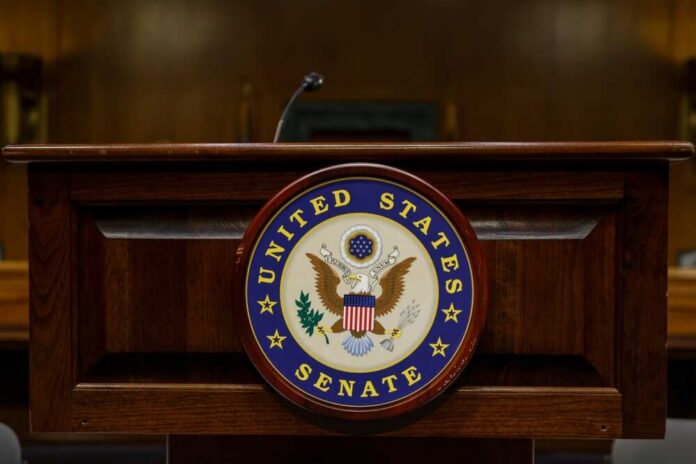
Senate Democrats are using the filibuster to block a citizenship-proof voter-registration bill Republicans say is basic election integrity—and GOP leaders are answering with a marathon floor fight meant to put every “no” vote on display.
Quick Take
- Republicans forced the SAVE Act onto the Senate floor in mid-March 2026 after the House passed it in 2025 and the Senate stalled for months.
- Senate Majority Leader John Thune scheduled an extended “marathon” session to keep the issue in the spotlight even without the 60 votes needed to break a filibuster.
- Democrats publicly vowed to block the bill, framing it as restrictive and warning it could complicate registration for millions of lawful voters.
- The bill’s fate is constrained by Senate math, but the debate is shaping 2026 midterm messaging around election rules, federal power, and trust in the system.
Why the SAVE Act fight erupted now
Senate Republicans brought the SAVE America Act to the floor in March 2026 after months of delay following House passage in 2025. The bill’s central idea is straightforward: requiring documentary proof of U.S. citizenship when registering to vote in federal elections. House Republicans publicly pressed the Senate to act after what they described as nearly 300 days of stalling, and the Trump White House elevated the measure into a top-tier priority.
Sen. John Thune’s strategy is not only about immediate passage; it is about forcing an extended public debate that keeps Democrats defending a filibuster on a bill branded as “voter eligibility.” That posture matters in a closely divided Congress where the Senate’s 60-vote threshold can stop almost anything. The result is a procedural brawl where both parties expect the other side to pay a political price.
What the bill changes—and where critics see federal overreach
The current controversy isn’t just “voter ID” in the everyday sense. It describes the SAVE Act as requiring documentary proof for voter registration, not for casting a ballot on Election Day. It also highlights provisions critics argue would expand federal involvement into election administration, including oversight tied to the Department of Homeland Security. That combination raises a familiar constitutional tension for conservatives: protecting election integrity without letting Washington centralize powers traditionally run by states.
Opponents also point to practical burdens. The Brennan Center’s analysis cited the estimates that millions of Americans could be affected by documentation requirements, especially citizens who do not have immediate access to passports or other proof. Election officials and voting-rights groups warn about administrative strain and confusion, particularly if Congress mandates new verification steps without providing new funding. Even many conservatives who favor cleaner voter rolls will recognize that unfunded federal mandates can create bureaucratic messes.
Democrats’ filibuster vow, and the politics behind the rhetoric
Democrats held press events and publicly committed to a filibuster as the bill reached the floor in March 2026. Their messaging argues the legislation is designed to restrict access rather than address a major real-world problem, with some citing “long-debunked” claims about noncitizen voting. On the Republican side, President Trump pushed aggressively for passage, while Democrats leaned into warnings that registration could become harder for lawful voters under strict documentary rules.
On the merits, it shows two realities moving at once. First, Senate math is a hard barrier: without 60 votes, the bill is unlikely to advance under normal rules, and at least one analyst suggested Republicans may not even have a secure 50. Second, the fight is still consequential because election rules are about legitimacy, and legitimacy is about public confidence. Republicans are using floor time to argue Democrats are blocking common-sense safeguards.
What happens next: gridlock now, messaging into the midterms
In the short term, the SAVE Act debate consumes floor time and intensifies Washington gridlock—exactly the kind of dysfunction voters say they hate. This indicates Republicans are using the prolonged session to pressure Democrats and elevate the issue ahead of the 2026 midterms, even if passage is unlikely. Democrats, meanwhile, appear prepared to stretch the battle for weeks, betting that “restriction” framing will energize their coalition and alarm swing voters.
Senate Republicans Delivered a Brutal Response to Democrats After the SAVE Act Vote
https://t.co/uKw1XHDZon— Townhall Updates (@TownhallUpdates) March 18, 2026
For conservative voters, the key takeaway is that this is now a test of priorities and power: whether Congress can tighten voter registration rules, and how far the federal government should go in supervising a process states historically run. This also notes polling showing voters prioritize other issues like the economy and war over “election integrity,” which means both parties are choosing this fight for strategic reasons. With the filibuster intact, the immediate outcome may be symbolic—but symbols shape campaigns.
Sources:
Democrats, Trump clash over anti-voting SAVE America Act as it reaches the Senate
SAVE Act Headed to Senate in Push to Restrict Voting Access
House Republicans Demand Senate Act on SAVE Act After Nearly 300 Days of Stalling