A massive “green” cold-storage warehouse packed with solar panels and 85 million pounds of food has turned into a weeks-long smoke and biohazard crisis in Boyle Heights, forcing Los Angeles to declare an emergency and leaving many residents asking how leaders let it get this bad.
Story Snapshot
- A solar-covered cold-storage warehouse fire in Boyle Heights has burned for days and sent smoke across Los Angeles.
- Mayor Karen Bass declared a local emergency to unlock more resources as officials warn about a looming biohazard from rotting food.
- Early fears centered on an ammonia leak and hazardous materials, but air tests later found mainly “normal” structure-fire smoke.
- Millions of pounds of spoiled meat and fish now pose an environmental and public-health headache for working-class neighborhoods.
How a Solar Roof Fire Became a Citywide Emergency
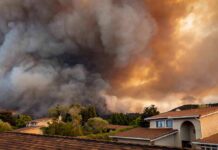
The blaze started Wednesday afternoon on the roof of a privately owned Lineage Logistics cold-storage warehouse in Boyle Heights, where contractors were reportedly testing solar panels when flames took off across the massive array.[3] The building is about 500,000 square feet and was used to store frozen food, not chemicals.[3] Thick black smoke poured over East Los Angeles and downtown, and officials ordered nearby residents to shelter in place over fears of hazardous air.[5][7][6]
Firefighters soon discovered an ammonia leak from the refrigeration system, forcing them into a defensive position while they shut valves and worked to confine the gas.[2][7] Crews later pumped ammonia off-site, and city and air-quality officials said monitoring showed no dangerous ammonia levels in surrounding neighborhoods.[6][8] That finding helped ease panic about an immediate toxic chemical cloud, but it did not solve the deeper problem: the fire was now burning inside a giant, tightly sealed freezer full of food, foam insulation, and steel walls.
Ammonia Fears Fade, But Smoke and Spoiled Food Take Center Stage
As the fire smoldered, Los Angeles Fire Department Chief Jaime Moore said the hazardous materials phase had been handled and that the response was shifting to a “biohazard” challenge from the warehouse’s contents.[7][8] Inside the structure sat about 85 million pounds of frozen meat, fish, and other products packed into a space designed to hold cold, not flames.[3][7][16] With refrigeration shut down and temperatures inside rising, officials warned that all that food was beginning to rot, turning the site into a massive, festering mess next to working-class homes.
Air-quality regulators reported something many locals could feel in their lungs: fine particle levels in several parts of the region rose to “Unhealthy for Sensitive Groups” and even “Very Unhealthy” as the smoke spread out from Boyle Heights.[2][4] At the same time, detailed testing by South Coast Air Quality Management District found no significant levels of toxic metals in the smoke and only trace amounts of bromine and chlorine at levels below short-term health thresholds.[8][4] Fire officials said that aside from typical structure-fire pollutants, there were no extra toxic chemicals in the air, even as residents complained about ash and a harsh plastic smell.
Why Mayor Bass Declared a Local Emergency
By Saturday, the fire was still not fully out, flare-ups kept sending new plumes into the sky, and city leaders admitted the operation was bigger than normal tools could handle.[7][3] Mayor Karen Bass issued a declaration of local emergency to tap state support under the California Disaster Assistance Act and to pull in more resources for round-the-clock work.[7][8][2] The goal was not just to finish off the deep-seated hot spots but also to plan how to safely remove and dispose of tens of millions of pounds of decomposing food without creating a second disaster.
Officials opened smoke-relief centers at locations like Pecan Recreation Center and City Terrace Park so families could get out of the haze and access clean air.[3][8] Emergency alerts urged people across central Los Angeles, San Gabriel Valley, and nearby valleys to limit outdoor activity and keep windows closed when they could see or smell smoke.[2][4] For many Boyle Heights residents, this sounded familiar: once again, a heavily Latino, working-class neighborhood was bearing the brunt of industrial risk while wealthier areas mostly watched on television.[16]
Questions About “Green” Infrastructure and Community Risk
Reports that the fire likely began during testing on the rooftop solar array added another twist.[3][1] The building was wrapped in dense foam and steel to hold in cold air for blast freezing, a design that also trapped heat and smoke once things went wrong.[3][1] The mix of rooftop solar equipment, ammonia-based refrigeration, and a huge food load shows how complex “modern” infrastructure can become—and how quickly it can turn into a nightmare when something sparks. Even after ammonia was secured, hydrogen fluoride from burning lithium-ion batteries was detected at low levels, reminding people that high-tech gear brings its own hazards.[16]
🚨🇺🇸#BREAKING | NEWS ⚠️
Airdrops continue for the Medline cold storage warehouse in Boyle Heights, Los Angeles. LAFD wants to collapse the roof as they continue to try to gain control of the fire which reignited and is still producing toxic smoke.A Boeing CH-470 Chinook with… pic.twitter.com/hep1iZc4VV
— Todd Paron🇺🇸🇬🇷🎧👽 (@tparon) June 21, 2026
For conservatives, the Boyle Heights fire highlights a pattern: regulators push solar mandates and dense urban industrial build-outs, but they do not seem prepared when these systems fail. Residents were told to trust the experts as shifting messages moved from “toxic ammonia leak” to “normal structure smoke” to “biohazard from spoiled food.”[2][4][8] While air tests so far back up the claim that major toxic spikes were avoided, the long-term costs of cleanup, lost food, and neighborhood stress will fall on taxpayers and local families, not on the policymakers who approved the setup.
Sources:
[1] Web – Los Angeles mayor declares emergency to fight Boyle Heights warehouse …
[2] Web – Boyle Heights shelter-in-place order lifted as LA firefighters …
[3] Web – What we know about Lineage storage facility – ABC7 Los Angeles
[4] Web – Thick black smoke and flames are erupting from a solar-paneled …
[5] Web – Latest Boyle Heights shelter-in-place order lifted as crews battle …
[6] YouTube – L.A. cold storage warehouse erupts in toxic inferno
[7] Web – ️Massive plume of thick black smoke seen for miles as firefight at …
[8] Web – View all – Instagram
[16] Web – Toxic Ash Cloud from Boyle Heights Warehouse Fire Affects …