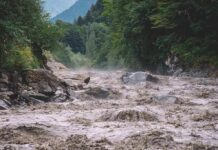

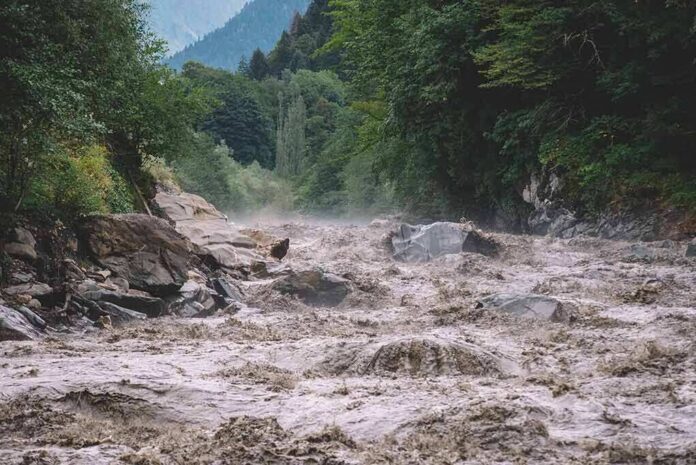
A wall of mud and water roared down Nepal’s Bhote Koshi River, killing scores and leaving hundreds of travelers unaccounted for.
Story Snapshot
- Police and rescue teams report confirmed deaths and active searches in northern Nepal.
- Nepal’s tourism agency lists hundreds of missing travelers, many from abroad.
- Early scientific reads link the flood to a glacier collapse in the high Himalayas.
- Damaged roads and bridges hinder rescue work across the Nepal–Tibet frontier.
Rescue Drive Intensifies After Deadly Border Flood
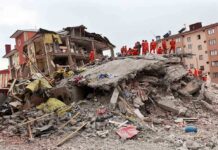
Nepalese police confirmed fatalities after a sudden flash flood swept through Rasuwa District and nearby areas along the Nepal–Tibet border. Officers said search and rescue teams are working in hard terrain with unstable slopes and broken roads. Local officials reported communities cut off by washed-out bridges and blocked river crossings. Photos and videos from the region showed shattered buildings and heavy debris. Authorities cautioned that numbers can change as crews reach new sites and recover victims.
Nepal’s tourism authority reported a large count of missing travelers following the surge. The agency said hundreds of people, including many foreign nationals, remain unaccounted for after the flood hit the Bhote Koshi River corridor, a busy route for trekkers and traders. The report highlighted the challenge of tracking visitors scattered across lodges, trails, and roadways. Officials urged families and tour operators to register information to help with identification and reunions.
What Triggered the Flood, And Why It Turned So Fast
Scientists and emergency analysts pointed to a collapse of ice and rock high in the Himalayas. That collapse rushed into a river valley, sending a fast, debris-choked flow downstream. Early technical briefings described a massive failure that created its own seismic signal, which first confused some observers tracking tremors. This type of cascade can move at highway speeds, gather boulders and trees, and hit towns with little warning. The result is heavy loss of life and severe damage in narrow canyons.
Regional studies warn that these high-mountain flood chains are growing more common as glaciers retreat and permafrost thaws. Past research in Nepal documents glacial lake outburst floods that can travel long distances and strike far below the ice line. Experts urge better mapping of lakes, stronger monitoring, and clear alert paths for villages downstream. While a full forensic report will come later, the early pattern fits known hazards in this mountain belt.
Broken Links: Roads, Power, And Cross-Border Coordination
Emergency crews faced blocked highways, snapped bridges, and damaged power projects on both sides of the frontier. Those breaks slowed helicopter lifts and ground convoys and left many areas without cell service. Responders focused on clearing key chokes to move fuel, food, and medical aid. Local leaders set up staging hubs where river valleys widen. Engineers began rapid checks on dams and pylons to prevent secondary failures as afterflows and rain kept slopes unstable.
🇳🇵 What caused the Nepal-Tibet flash floods?
A huge piece of ice that fell thousands of metres from a glacier into a river below may have unleashed the disaster in Nepal and Tibet. Here is what experts believe happened. pic.twitter.com/Yh8CuUs4ED
— AFP News Agency (@AFP) August 28, 2026
For families in Nepal and abroad, the hardest task is waiting. Rescue teams must balance speed with safety on loose ground. Officials asked the public to avoid rumor mills and use official lines to share names, photos, and last-known locations. Tourism operators prepared manifests, passport copies, and contact trees to aid identification. Police said they will release confirmed information in batches, and reminded that an active search does not mean a final outcome for the missing.
Sources:
freemalaysiatoday.com, chosun.com, reuters.com, lib.icimod.org, link.springer.com