

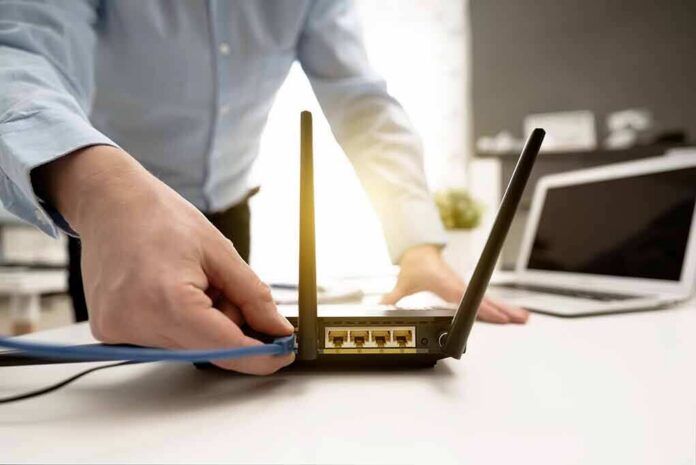
Engineers are baking “see-through-walls” sensing into Wi‑Fi standards, turning everyday routers into motion and presence detectors inside our homes and offices.
Story Snapshot
- IEEE’s 802.11bf effort defines Wi‑Fi sensing for motion, presence, proximity, and gestures.
- The standard targets both sub‑7 gigahertz and 60 gigahertz bands, signaling wide rollout.
- Carnegie Mellon researchers showed body pose detection using Wi‑Fi signals alone.
- Survey research confirms active work on Wi‑Fi‑based human identification, but it remains hard at scale.
Standards Move Wi‑Fi From Communication To Sensing
IEEE working groups defined Wi‑Fi sensing as using received signals to detect features of targets, including human presence, motion, proximity, and gestures. The 802.11bf work scopes sensing in homes, vehicles, offices, and more. Draft materials explain how devices can gather sensing data at the physical and media access layers. That means sensing is not a side hack. It is part of the planned protocol. This shift changes routers into room‑awareness devices by design, not by accident.
The same documents say sensing will work in sub‑7 gigahertz and 60 gigahertz millimeter wave bands. Those bands behave differently in walls and open areas, so support across both widens use. Vendors can tune features for range or detail. The approach is called integrated sensing and communication. It blends data transfer with environment awareness in one network. This design choice hints at mainstream products, not niche gear, once the work is finalized.
Lab Results Show People And Poses Without Cameras
Researchers at Carnegie Mellon University built a system that infers human body poses using Wi‑Fi only. Reports say it takes amplitude and phase data from three transmit signals captured by three receivers. A neural network then maps a coarse grid to likely body joints for multiple people in a room. The team reported strong detection scores in tests. These results show that routers can reveal more than simple motion. They can sketch how people stand and move.
Academic survey work catalogs progress on recognizing people with Wi‑Fi signals. The survey describes scenarios, methods, and common hurdles. It shows this is an active research area with many approaches and datasets. Still, wide, real‑world identification of arbitrary people remains a hard problem. That bar is higher than motion, presence, or pose. The evidence here supports clear sensing gains. It does not prove universal, reliable identity across messy, everyday spaces.
Why This Matters For Privacy, Power, And Daily Life
Built‑in sensing could help with safety, elder care, and energy savings. Routers could detect a fall, dim lights in empty rooms, or guide robots. But the same features can map routines and reveal when someone is home, asleep, or pacing. Because sensing can work without phones or cameras, people may not know it is happening. That deepens long‑running worries on both the right and left about unseen surveillance by large companies and government.
Americans across parties already doubt that leaders protect basic rights. Many feel elites write rules for themselves and hide trade‑offs from the public. Wi‑Fi sensing fits that pattern. Standards push forward because it is useful and cheap to deploy. Hardware is already in our homes. That lowers costs for companies and agencies. Without clear rules, default settings could normalize quiet tracking through walls, with few ways to opt out or audit who is listening.
What To Watch: Policy Guardrails And Product Choices
Lawmakers can set bright lines for home and workplace sensing. Clear consent, on‑device processing by default, and data minimization can cut risks. Firmware should let users turn sensing off completely. Logs should show when sensing ran and where data went. Companies should avoid identity‑level claims unless they pass strict, public tests. Regulators can demand simple labels so buyers know when routers include motion or pose features at the point of sale.
For readers, a few steps help today. Check your router settings for any motion or presence features. Review your internet provider’s privacy terms for “Wi‑Fi sensing” or “home awareness.” Ask workplaces and landlords if they use these features in shared spaces. Push vendors to process data locally and to store nothing that is not needed. Small moves like these can keep useful tools while guarding the private spaces where families live and work.
Sources:
reclaimthenet.org, internet-satelitarny.eu, dl.acm.org