Gavin Newsom’s final $349 billion California budget leans on an AI-fueled tax windfall while leaving the state’s structural debt problem squarely in the laps of future taxpayers.
Story Snapshot
- Newsom’s $348.9 billion 2026–27 budget depends heavily on volatile AI/tech-driven tax revenue to paper over long-term deficits.
- The governor claims only a $3 billion gap, while the state’s own Legislative Analyst warned of a shortfall closer to $18 billion.
- Spending grows for education, Medi‑Cal, climate projects, and homelessness even as California’s tax base and businesses keep fleeing.
- Critics say Newsom is “kicking the can” on pensions, debt, and structural overspending to protect his political legacy.
Newsom’s Rosy Budget vs. California’s Harsh Fiscal Reality
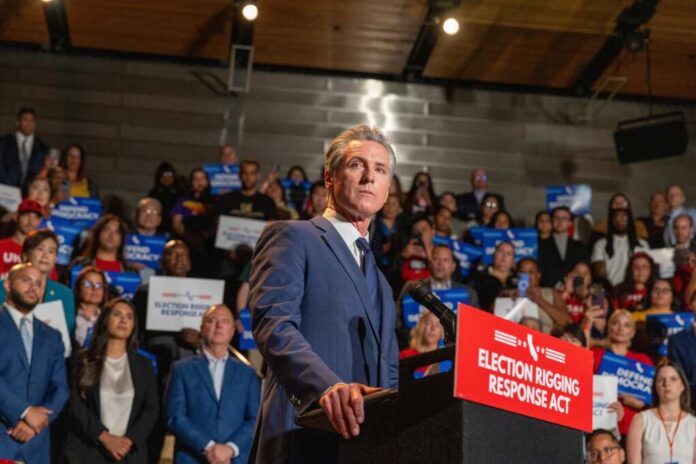
Gavin Newsom has unveiled a roughly $348.9 billion budget for 2026–27, touting it as disciplined and responsible while leaning almost entirely on stronger-than-expected revenues from California’s AI-fueled tech boom. His Department of Finance now projects only a modest $2.9–3 billion deficit, a far cry from the nearly $18 billion shortfall the state’s nonpartisan Legislative Analyst’s Office warned about just months earlier. The sharp gap reflects a political choice to gamble on continued market strength rather than confront overspending.
California’s tax system leans heavily on high-income earners and capital gains, meaning the budget soars when stocks rise and collapses when markets turn. During the pandemic boom, Newsom and Democrats locked in multi-year commitments in education, climate, health care, and homelessness on the assumption that the gravy train would never stop. When revenues cooled, they resorted to deferrals and fund shifts instead of real cuts. This latest proposal continues the pattern: paper over the cracks, hope the Dow and Silicon Valley save the day.
Gavin Newsom proposes $350B California budget — kicks the can on debt https://t.co/nSyWogy2W3 pic.twitter.com/uU2901rMz6
— New York Post (@nypost) January 9, 2026
AI Boom, Big Government, and the Risk Dumped on Taxpayers
Newsom’s team now points to more than $42 billion in extra General Fund revenue over several years compared with prior forecasts, much of it driven by AI-linked corporate profits and capital gains. Instead of using that windfall to seriously pay down long-term obligations and shrink the state’s footprint, the budget refills reserves to about $23 billion and then spreads money across favored priorities. On paper, that looks cautious; in practice, it assumes the boom never busts and leaves taxpayers exposed when the cycle turns.
Spending Priorities: Woke Era Programs Locked In
Despite the supposed discipline, spending continues to grow in the very areas that defined California’s progressive experiment. The budget fully funds “universal transitional kindergarten” and expands preschool and so-called “community schools” that bundle academics with a broad suite of social services. It boosts funding for the University of California and Cal State systems while pushing community college expansion under long-term access plans. These choices cement commitments created during the pandemic surplus years instead of recalibrating to a leaner, more sustainable government.
On the health front, the proposal devotes roughly $222.4 billion to Medi‑Cal, covering around one-third of the state’s population. That massive healthcare commitment reflects years of expanding eligibility and benefits, including for people with questionable or unresolved immigration status.
Climate, Homelessness, and the Cost of Progressive Ambitions
Newsom also doubles down on climate and environmental spending, adding money for wildfire programs, zero-emission vehicle incentives, and water and wastewater projects aimed at “disadvantaged” and tribal communities. Meanwhile, homelessness funding continues through another $500 million for flexible local grants, despite years of soaring homeless counts and visible disorder in California’s major cities.
Local governments and county associations warn that federal cuts to Medicaid and social programs will strain their budgets, yet Newsom’s blueprint does not fully backfill those gaps. That means the real-world pain gets pushed down to sheriffs, hospitals, and community services, even as Sacramento celebrates its rebuilt Rainy Day Fund.
Sources:
Gavin Newsom forecasts rosier California budget and banks on AI boom continuing
Governor Newsom announces proposed budget that refills the state’s Rainy Day Fund, protects previous accomplishments and makes historic investments in education
Newsom’s budget plan banks on strong revenues despite fiscal risks
Newsom’s last state budget leans on strong revenues while deferring tougher choices
As part of the 2026–27 budget proposal, Governor Newsom proposes improving state education governance
Governor’s 2026–27 proposed budget: implications for family physicians and Medi-Cal