

President Trump’s unprecedented executive order declaring Antifa a domestic terrorist organization has ignited a fierce national debate over constitutional rights, government power, and the future of American protest.
Story Snapshot
- President Trump’s executive order labels Antifa a “domestic terrorist organization,” directing an all-of-government crackdown.
- The move tests the boundaries of executive power, targeting a decentralized movement rather than a formal group.
- Legal experts and civil liberties advocates question the order’s constitutionality and effectiveness.
- Heightened scrutiny of left-wing activism raises concerns about free speech and protest rights.
Trump’s Executive Order: A New Front in the Battle Over Domestic Terrorism
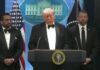
On September 22, 2025, President Donald Trump signed an executive order (EO) that designated Antifa—a decentralized network of left-wing activists—as a “domestic terrorist organization.” According to a White House fact sheet, the order initiates a sweeping effort by agencies from the Department of Justice to Homeland Security and the FBI to dismantle what the administration calls “left-wing terrorism.” The EO describes Antifa as a “militarist, anarchist enterprise that explicitly calls for the overthrow of the United States Government, law enforcement authorities, and our system of law.” The administration has said the executive order is a response to what it views as a trend of “Radical Left violence.”
Federal agencies have been directed to “utilize all applicable authorities to investigate, disrupt, and dismantle any and all illegal operations” conducted by those associated with Antifa. The White House has cast the measure as a law-and-order victory.
Legal and Constitutional Hurdles: Uncharted Territory for Executive Power
Despite the administration’s messaging, the executive order faces significant legal challenges. The United States does not have a federal statute that allows a president to designate a domestic group as a terrorist organization. This authority has historically been reserved for foreign groups. According to the Congressional Research Service, Antifa is a “decentralized” movement that lacks a “unifying organizational structure or detailed ideology.” Former FBI Director Christopher Wray, appointed by Trump, has also described Antifa as “a movement or an ideology,” not a formal organization.
Legal experts and civil liberties organizations, including the American Civil Liberties Union (ACLU), have warned that the order may overstep constitutional boundaries. Hina Shamsi, director of the ACLU’s National Security Project, stated that “the president does not have legal authority to designate a domestic group as terrorists for good reason, as any such designation will raise significant First Amendment, due process and equal protection concerns.” Critics argue that targeting an ideology risks being used as a precedent to suppress dissent or label political opponents as security threats.
Impact on Civil Liberties, Political Climate, and Law Enforcement
The executive order has led to a surge in law enforcement scrutiny of left-wing activism, with reports of increased surveillance and investigations into individuals suspected of having “Antifa” connections. This has raised concerns about a potential “chilling effect” on protest and free expression.
Politically, the order has sharpened divisions. Supporters of the administration view the action as a necessary step to address political violence. Opponents counter that the order is a political maneuver designed to intimidate ideological adversaries. As federal agencies roll out new enforcement protocols, the nation is bracing for legal battles and a contentious debate about the future of free speech and the limits of government authority.
Trump Signs ‘All-of-Government Effort to Dismantle Left-Wing Terrorism,’ Antifahttps://t.co/hjTAvnEu2h
— Karoline Leavitt (@PressSec) September 26, 2025
Sources:
Cato Institute analysis of the executive order
Official White House executive order and statements
ACLED data and expert Q&A on Antifa’s structure and activities
Official White House executive order and statements
Official White House statement: President Trump isn’t backing down from crushing radical left violence