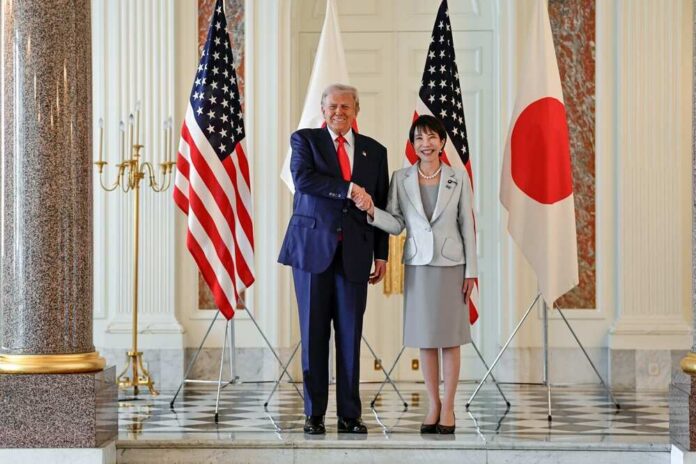
President Trump delivers a warm White House welcome to Japan’s conservative Prime Minister Sanae Takaichi, strengthening alliances while the usual suspects outrage over a harmless Pearl Harbor joke.
Story Highlights
- Trump hosts Takaichi for bilateral meetings and dinner on March 19, 2026, praising Japan for stepping up on Iran amid global tensions.
- Key deals include potential U.S.-Japan mine sweeper collaboration for Strait of Hormuz and a $40 billion U.S. reactor project.
- Trump contrasts reliable Japan with lagging NATO allies, pushing fair burden-sharing.
- Light-hearted Pearl Harbor reference draws predictable backlash from critics, ignoring the positive rapport.
- Takaichi, Japan’s first female PM and nationalist leader, affirms deep U.S. trust amid China and Iran threats.
White House Bilateral Meeting Focuses on Iran and Alliance Strength
On March 19, 2026, President Donald Trump met Japanese Prime Minister Sanae Takaichi at the White House for morning and afternoon discussions. Topics covered Iran tensions, trade, China challenges, energy security, and the U.S.-Japan alliance. Trump highlighted Japan stepping up unlike NATO, praising their support as Iran disrupts the Strait of Hormuz with closures and attacks. Takaichi condemned Iran’s actions from the start, thanking Trump for deep trust. This follows her March 18 warning of a difficult meeting, yet rapport proved strong.
Potential Collaborations on Security and Energy Announced
Trump announced potential U.S.-Japan teamwork on mine sweepers for the Hormuz Strait and eyed control of Karg Island to counter disruptions. A $40 billion U.S. reactor project emerged as a major energy tie, boosting Japan’s security interests. Treasury Secretary Scott Bessent suggested U.S. takeover options. These moves address global oil chaos from Iranian attacks and Israel’s March 18 strike on an Iranian gas field. Trump urged de-escalation via Truth Social, confirming U.S. awareness of Israeli operations without participation. No new U.S. troops committed.
Formal Dinner Caps Positive Diplomacy
The day ended with a formal evening dinner after welcoming ceremonies, solidifying the warm personal relationship Trump described as very fine. Takaichi emphasized unwavering alliance commitment amid Indo-Pacific strains from China. This visit, postponed earlier, underscores Japan as a reliable partner contrasting multilateral laggards. Trump criticized past administration costs tangentially, reinforcing his America First push for allies to contribute fairly without U.S. overstretch.
Leftist Critics Flip Out Over Trump’s Joke
During talks, Trump made an offhand Pearl Harbor reference, a nod to WWII history in the strong U.S.-Japan alliance context. Critics, labeled usual suspects, sparked backlash over perceived insensitivity, despite the positive tone. Sources frame it as pragmatic diplomacy amid crisis, with Bloomberg noting a relatively warm welcome despite Takaichi’s prior fears. This amplifies partisan divides but highlights Trump’s straightforward style versus woke overreactions.
Japanese PM and Trump Share Sweet Moments During White House Visit As Usual Suspects Flip Out Over Jokehttps://t.co/w2GZxPqn60
— RedState (@RedState) March 20, 2026
Broader Impacts Bolster Conservative Priorities
Short-term, these steps enhance deterrence against Iran and China, stabilizing Hormuz oil flows critical for American families hit by past inflation. Long-term, they set burden-sharing precedents, strengthen bilateral ties over globalism, and advance nuclear energy independence. Economic wins include reactor investments; defense gains from mine sweepers. Japan expands its security role, pressuring others like NATO. Amid U.S.-Iran escalations, Trump’s leadership prioritizes American interests and traditional alliances.
Sources:
President Trump hosts dinner with Prime Minister Sanae Takaichi (White House/FOX)