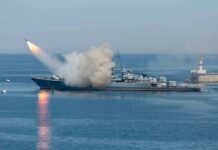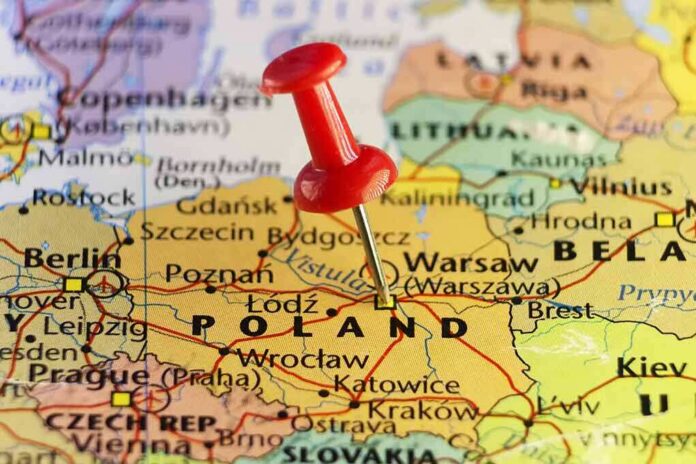
A Russian missile barrage that killed civilians across Ukraine also sent at least one missile into NATO airspace and onto Polish soil, jolting fears that the war is creeping closer to home.
Story Snapshot
- Russian strikes across Ukraine killed at least nine people and wounded dozens more overnight.
- Poland reported an unidentified object crossing its border and crashing near Tarnawa-Kolonia during the attack.
- NATO warplanes were scrambled and air defenses activated after the missile briefly entered alliance airspace.
- Polish experts are still examining debris, and officials have not called it a deliberate strike on Poland.
Russian Barrage Batters Ukraine and Spills Into NATO Airspace
Ukrainian officials said Russian forces launched a large overnight wave of missiles and drones that struck multiple regions from east to west, killing at least nine people and injuring many more. Rescue teams in several cities reported homes, businesses, and energy sites destroyed or damaged as people slept. In the Dnipropetrovsk region, regional leaders said a mass strike killed six and wounded others, while attacks near the western city of Lviv injured dozens as buildings collapsed or burned.
During the same barrage, Ukraine’s capital Kyiv was again hit by ballistic missiles, which killed a 31-year-old man and wounded others, according to the national police. Ukrainian emergency services described a familiar but growing problem: repeated large-scale attacks are wearing down air defenses and forcing constant repairs to power and heating systems. These strikes follow weeks of similar waves where Russian forces used drones and missiles to pressure Ukraine’s cities far from the front lines.
Missile Crosses Into Poland and Triggers NATO Air Response
Polish authorities said radar picked up an unidentified object entering Polish airspace from the direction of Ukraine and crossing near the rural area of Tarnawa-Kolonia while the Russian attack was underway. Officials reported that the object then crashed in open countryside, leaving a crater and scattered debris consistent with an impact. No injuries were reported in Poland, but the fact that something fell inside NATO territory alarmed leaders in Warsaw and in allied capitals.
NATO officials said alliance warplanes were scrambled and ground defenses activated after the missile briefly crossed into Polish airspace, describing it as a Russian cruise missile linked to the overnight barrage on Ukraine. The missile reportedly flew only a short distance into Poland before crashing, but the move still counted as a violation of alliance airspace. NATO’s secretary general publicly backed Poland and repeated that the alliance will defend every inch of its territory, while also stressing that there was no sign of a wider Russian offensive against NATO at that moment.
Poland Opens Investigation as Leaders Seek to Avoid Escalation
Polish leaders quickly launched a criminal and technical investigation but stopped short of calling the incident a deliberate Russian strike on their country. Officials said military and forensic experts are studying fragments and crater patterns to confirm exactly what type of missile hit and whether it malfunctioned, strayed off course, or was guided toward targets in Ukraine near the border. Authorities also promised to review radar logs and air-defense data from the incident window.
NATO jets scramble as Russian missile detonates in Poland | Russia-Ukraine war News | Al Jazeera https://t.co/cRy7rqsEso via @AJEnglish
— Luis Toro (@LuisTorohzgk) July 31, 2026
NATO’s response followed a pattern seen in past border incidents, including a 2022 blast in another Polish village later linked to a Ukrainian air-defense missile fired against Russian attacks. Then, as now, allies rushed to consult, share radar data, and calm fears of automatic escalation to a wider war. Leaders again walked a narrow line: signaling that Russia’s campaign is driving dangerous spillover risks, while trying not to give Moscow a pretext to claim that NATO is entering the war directly.
Why This Scares People Across the Political Spectrum
For many Americans watching from afar, this episode confirms a fear that the Russia–Ukraine war can jump borders without warning and pull the United States and NATO into a direct clash with a nuclear power. Older conservatives worry that global entanglements and open-ended commitments could drag U.S. troops into another conflict while problems at home, from the border to inflation, remain unsolved. They see a system that always finds money for foreign crises but rarely fixes broken policies at home.
Older liberals look at the same incident and see different failures but the same pattern. They worry about growing gaps between the rich and everyone else, and they question whether the costs of war and rearmament will deepen those divides. Both sides suspect that powerful insiders and defense contractors gain influence and profit when tensions rise, while ordinary families face higher prices, energy shocks, and the constant risk that a single “accident” could change history overnight.
Unanswered Questions and the Risk of False Certainty
Polish officials have not yet released a full forensic report tying the debris to a specific missile model or publishing radar tracks of the missile’s full path. That leaves room for questions about whether this was a guidance failure, a misfire near the border, or a different kind of munition. Past cases show that early assumptions can be wrong: in 2022, some leaders first suspected a Russian strike in Poland, but later evidence pointed to a Ukrainian interceptor missile fired in self-defense.
These gaps in public information fuel suspicion among citizens who already believe governments hide the full truth to manage public opinion. Many people across the left and right feel that unelected security officials and international bureaucracies make life-and-death decisions with little accountability. They worry that one misread radar return, one broken wire inside a missile, or one rushed press conference could push NATO and Russia closer to direct war before the public even understands what happened or has a say.
Sources:
military.com, deccanchronicle.com, devdiscourse.com, bbc.com, latimes.com, abc7ny.com, cepa.org