

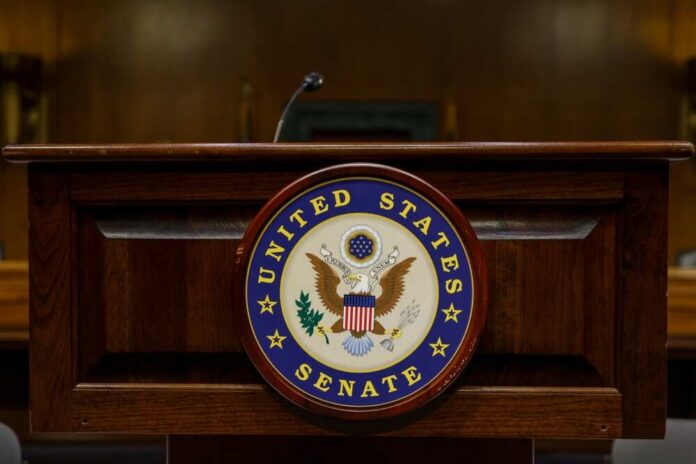
Four Republican senators broke ranks with their party to hand Democrats a symbolic but significant procedural win — advancing a resolution that would force President Trump to get congressional approval before continuing military operations against Iran.
Story Snapshot
- The Senate voted 50-47 to advance S.J.Res. 185, a joint resolution directing the removal of U.S. forces from hostilities with Iran absent congressional authorization.
- Four Republicans — Bill Cassidy, Rand Paul, Susan Collins, and Lisa Murkowski — joined Democrats to push the measure forward on its eighth attempt.
- The vote was a procedural discharge motion, not final passage — the resolution still faces additional legislative hurdles before it could become law.
- The Trump administration has asserted it already holds authority to strike Iran without congressional approval, citing an imminent danger justification.
Senate Forces a War Powers Showdown
The Senate voted 50-47 on May 19, 2026, to advance S.J.Res. 185, a joint resolution that would direct the removal of United States Armed Forces from hostilities against Iran that have not been authorized by Congress. The vote — officially recorded as a “Motion to Discharge Agreed to” — marked the eighth attempt by Democrats to pass such a measure, and the first time any version successfully cleared a procedural threshold in the current Congress.
Senator Tim Kaine of Virginia led the effort, framing the resolution around the War Powers Resolution of 1973, which requires the president to notify Congress within 48 hours of military action and prohibits armed forces from remaining engaged for more than 60 days without congressional authorization. Proponents argued the Iran operation had exceeded that statutory window, triggering Congress’s legal authority to act.
Four Republicans Cross the Aisle
The decisive shift came from four Republican senators who voted with Democrats: Bill Cassidy of Louisiana, Rand Paul of Kentucky, Susan Collins of Maine, and Lisa Murkowski of Alaska. Their defections gave Democrats the narrow majority needed to advance the resolution past a procedural block that had stalled seven previous attempts. Without all four, the measure would have failed along party lines as it had repeatedly before.
Senator Cassidy’s vote drew particular attention given his political circumstances. His decision to side with Democrats on a high-profile rebuke of the president drew immediate backlash from Trump allies. Rand Paul’s support was more predictable — he has consistently opposed executive overreach in military matters regardless of which party holds the White House, a position rooted in his long-standing non-interventionist principles.
A Procedural Win, Not a Final Verdict
Despite the political significance, the 50-47 vote did not enact any restriction on presidential authority. The Senate’s action was a discharge motion — a procedural step that moves the underlying resolution forward for further consideration. The resolution still requires additional votes before it could reach the president’s desk, and a presidential veto would almost certainly follow. Even supporters acknowledged the result was “not a final outcome” in the broader constitutional dispute.
US Senate votes to limit Trump's war powers in Iran war | World Israel News https://t.co/15hndAU50F
Three Democrats with an R and one Constitutionalist.Rand Paul of Kentucky, Susan Collins of Maine, Lisa Murkowski of Alaska and Bill Cassidy of Louisiana joined nearly all…
— Robin V (@RobinValente60) May 20, 2026
The Trump administration pushed back immediately, asserting that the president retains independent constitutional authority to respond to imminent threats without prior congressional approval. This executive position reflects a long-standing pattern across administrations of both parties — presidents routinely defend broad unilateral authority in fast-moving military situations, while Congress periodically uses war-powers resolutions as both a legal instrument and a political signal. The War Powers Resolution of 1973 was itself born from congressional frustration over Vietnam-era executive overreach, and disputes over its application have never been fully resolved in the courts. What is clear is that this vote, however procedurally limited, signals growing bipartisan unease with open-ended military engagement — and sets up a larger confrontation over who ultimately decides when America goes to war.
Sources:
[1] YouTube – “A BIG F-You to Trump” – Senate War Powers Vote 50-47 …
[3] Web – Roll Call Vote 119 th Congress – 2 nd Session – Senate.gov
[4] YouTube – ‘Not a war of the American people’, analyst says as ordinary citizens …
[5] Web – Senate Rejects War Powers Measure | Council on Foreign Relations
[6] Web – and lose — war powers resolution votes – WSHU
[7] YouTube – Senate passes measure limiting Trump’s war powers in Iran
[8] Web – Roll Call Vote 119 th Congress – 2 nd Session – Senate.gov
[9] YouTube – Sen. Cassidy flips his vote to help pass the war powers …
[10] Web – Senate advances resolution to limit Trump’s Iran war powers for first …
[11] Web – War Powers Resolution of 1973 | Richard Nixon Museum and Library
[12] YouTube – Senate votes on war powers resolution