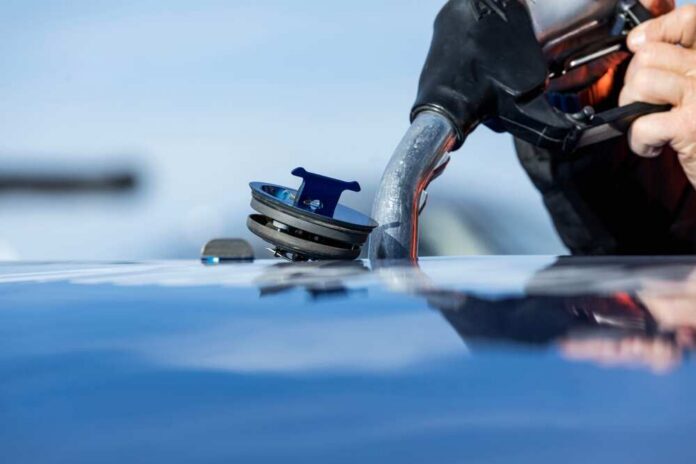
Hundreds of UK petrol stations — including major supermarkets — are breaking a new law that requires them to report live fuel prices within 30 minutes, and real fines are now on the table.
Story Snapshot
- Since February 2, 2026, every UK petrol station must report price changes to a central database within 30 minutes under the new Fuel Finder scheme.
- Around 1,613 stations are failing to meet that requirement — putting them in breach of the law.
- The Competition and Markets Authority (CMA) ended its grace period on May 1, 2026, and can now fine stations up to 30% of their annual turnover.
- Drivers who spot a mismatch between an app price and the pump price can report it directly to the CMA at gov.uk/cma.
What the Fuel Finder Law Requires
Since February 2, 2026, every petrol station in the UK has been legally required to report any pump price change to a central government database within 30 minutes. The rule comes from the Motor Fuel Price (Open Data) Regulations 2025. A company called VE3 Global runs the database on behalf of the Department for Energy Security and Net Zero. Apps like Waze, PetrolPrices, MyRAC, and the AA then pull that live data so drivers can find the cheapest fuel nearby.
The Competition and Markets Authority (CMA) launched the Fuel Finder scheme after its own research found that fuel profit margins stayed “persistently high” even as pump prices fell. The CMA said those high margins could not be explained by rising costs alone. Forcing every station to publish live prices was meant to push stations to compete harder — and give drivers a real chance to shop around before pulling in.
Hundreds of Stations Are Breaking the Law
Around 1,613 petrol stations — including some supermarket forecourts — are currently failing to update their prices on time, putting them in breach of the law. For the first three months after the rule took effect, the CMA focused on helping stations get set up rather than handing out penalties. That grace period ended on May 1, 2026. From that date, the CMA confirmed it will prioritize enforcement action against non-compliant stations.
The CMA has several tools it can use against stations that break the rules. It can issue an information notice, forcing an operator to hand over documents under legal compulsion. It can issue a compliance notice requiring the station to fix the problem within a set time. And it can impose financial penalties of up to 30% of a station’s annual turnover. The size of any fine depends on how long the breach lasted, whether the operator tried to hide it, and the size of the business.
What Drivers Can Do Right Now
If you pull into a petrol station and the price on the pump is higher than what an app showed you, that is exactly the kind of breach the scheme is designed to catch. The CMA advises drivers to take a timestamped photo of the forecourt price board and report the gap at gov.uk/cma. Most complaints go first to VE3 Global, which contacts the station directly. If the station refuses to fix the problem, the case moves up to the CMA for formal action.
Hundreds of UK petrol stations are failing to meet legal requirements for reporting live price changes.
Analysis of data submitted to Fuel Finder suggests around 570 sites haven't provided any costs to a government system aimed at saving drivers money.
That's despite this being… pic.twitter.com/atBw2Tsthb
— Go Radio (@thisisgoradio) July 7, 2026
The stakes for drivers are real. The CMA estimates that choosing the cheapest station within a five-minute drive could save the owner of a typical family car up to £4.50 per tank. Supermarket forecourts already tend to charge about 3p per litre less than average — roughly £1.50 saved on a full tank. But those savings only work if the price data drivers see on their phones is accurate and up to date. That is exactly what the Fuel Finder scheme is designed to guarantee — and why breaking it is now a serious legal matter.
Sources:
ccpc.ie, bbc.com, facebook.com, linkedin.com