President Donald Trump again joked that Senator Ted Cruz would receive unanimous Senate confirmation to the Supreme Court because lawmakers from both parties would want him out of Congress, prompting Cruz to reiterate that he has no interest in serving on the high court.
Story Snapshot
- President Trump has repeatedly floated Senator Ted Cruz as a Supreme Court pick, claiming Cruz would get unanimous support because both parties want him out of Congress.
- Cruz has just as clearly and repeatedly said “hell no,” explaining he wants to stay in the political fight instead of becoming a judge.
- The exchange renewed discussion about how Supreme Court vacancies are increasingly part of broader political messaging.
- The episode reinforces a bigger worry: the ruling class treats power like a game while ordinary people struggle to reach the American Dream.
Trump’s Cruz Supreme Court Talk: Joke, Trial Balloon, or Warning Sign?
President Donald Trump has now floated Senator Ted Cruz’s name for the Supreme Court more than once, mixing praise with sharp humor. At a Washington event on “Trump Accounts” for children, Trump called Cruz “a brilliant legal mind” and said that, if he nominated him, he would get “100% of the vote.” He told the crowd Democrats and Republicans alike would back Cruz just to “get him the hell out” of the Senate, drawing laughter and headlines. Trump made a similar point at a rally in Bemidji, Minnesota, again saying Cruz could win all 100 Senate votes. Each time, the message was the same: Cruz is smart and loyal, but also such a thorn in everyone’s side that the political class would gladly ship him off to a lifetime seat.
No formal nomination has been filed for Cruz, and nothing has gone to the Senate Judiciary Committee. Under the Constitution’s appointments clause, a real nomination would require an official notice to the Senate, vetting by the Judiciary Committee, hearings, and a final vote. None of that has happened. Trump has made the remarks publicly, but no formal nomination process has begun.
Cruz’s Firm “Hell No”: Why He Says He Won’t Take the Robe
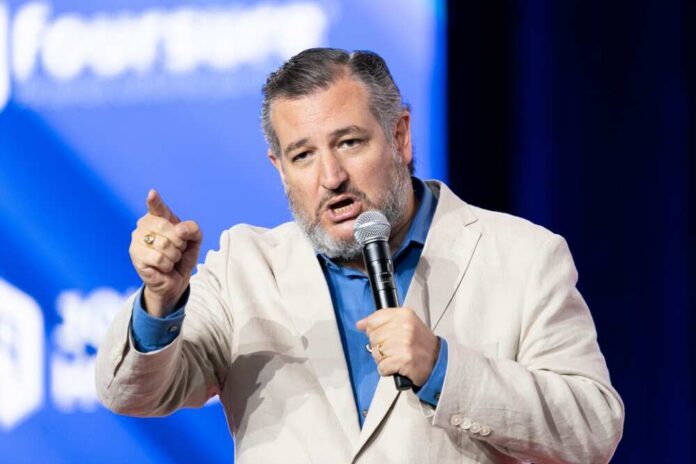
Senator Ted Cruz is not playing along. Asked about Trump’s idea, Cruz answered, “My answer’s not just no, it’s hell no.” He told reporters that Trump had “serious conversations” with him about all three Supreme Court vacancies in the first term, and he said no every time. Cruz explained why: a “principled federal judge stays out of policy fights and stays out of political fights,” and he does not want to stay out. He said he wants to be “right in the middle” of those battles, helping write laws, shape arguments, and push the country in a direction he believes in. Coming from a former clerk to Chief Justice William Rehnquist and Texas solicitor general, that is a clear choice: power through politics, not through a robe and gavel.
Cruz’s refusal also shows how deeply both sides now see the Supreme Court as part of a larger war over the country’s future. Cruz says he cares “deeply” about putting “principled constitutionalists” on the court and has helped move hundreds of conservative judges through the Senate. But he insists his role is as a fighter and deal‑maker, not as a referee. For conservatives who feel courts have been used to force woke agendas or twist the Constitution, Cruz’s stance can seem like a promise to keep battling from the elected branches. For liberals who worry about hard‑line “America First” policies, his refusal may feel like dodging scrutiny that a public Supreme Court hearing would bring. Either way, it underscores how few people in power are willing to step away from the partisan brawl, even when offered one of the highest judicial jobs in the land.
What This Episode Reveals About Today’s Washington
The exchange illustrates how Supreme Court discussions have become part of broader political messaging beyond the formal judicial nomination process. The Supreme Court nomination process is supposed to be careful and slow, with deep vetting, public hearings, and hard questions about law and liberty. Since 1975, it has taken about two months on average from nomination to final Senate vote, because lifetime power over the Constitution is at stake. Yet here, the idea of a Cruz nomination is used mainly as a punchline about how hated one senator is, and as a way to stir up supporters tired of “the swamp.” Many citizens on both the right and the left see this and feel the same thing: the people in charge treat these choices like moves on a game board, while economic pain, immigration chaos, and cultural division deepen.
⚖️ President Trump Dropped Hilarious Bombshell on a Senator Ted Cruz Supreme Court Nomination:
President Trump had the crowd roaring with one of his signature zingers, turning a question about elevating Senator Ted Cruz to the Supreme Court into a masterclass in political humor… pic.twitter.com/90zf1HREK1
— Donnie Cope (@dcopechatter) July 6, 2026
Trump’s claim that Cruz would get “100%” bipartisan support also highlights how far today’s politics has drifted from honest debate. In reality, recent Supreme Court rulings on hot‑button issues have often split 5‑4 or 6‑3, showing deep ideological divides. No serious observer believes all 100 senators would line up behind a hard‑charging conservative like Cruz; the line is a joke that lands because many Americans think senators care more about comfort in the Capitol than about serving the people. That feeling cuts across party lines. Conservatives blame globalists, woke elites, and big‑spending bureaucrats. Liberals blame corporate power, fossil‑fuel interests, and attacks on minorities. But both sides increasingly agree on this: the federal government looks like a club of insiders, and the Supreme Court is just another lever they pull.
Sources:
townhall.com, thehill.com, cruz.senate.gov, instagram.com, youtube.com, facebook.com, texastribune.org, fec.gov, supremecourt.gov, politico.com, constitutioncenter.org