The Federal Bureau of Investigation quietly told border agents to stand down on a planned airport interrogation of a Wuhan-linked virus researcher, raising fresh questions about who Washington really protects and why.
Story Snapshot
- Senator Rand Paul released internal records showing the FBI stopped border agents from questioning virologist Peter Daszak about his Wuhan lab work.
- Customs and Border Protection had flagged Daszak as a “high person of interest” and drafted detailed questions about possible sample collection in China.
- The Department of Health and Human Services later suspended and then banned Daszak and EcoHealth Alliance from federal funding over Wuhan-related oversight failures.
- The case feeds a wider worry that federal agencies protect insiders while everyday Americans pay the price for pandemic mistakes and opaque decision-making.
Rand Paul’s files: what the border agents were told to do—and not do
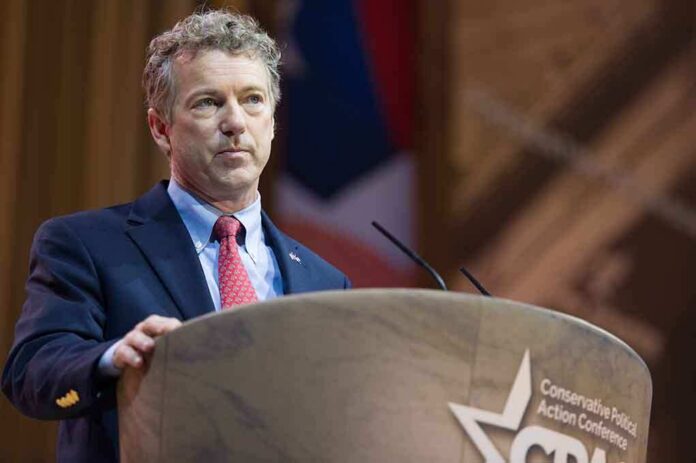
Senator Rand Paul, who leads the Senate Homeland Security Committee, has posted a public database of federal records from his investigation into the origins of COVID-19. Among them are Customs and Border Protection plans to question British-born virologist and EcoHealth Alliance president Peter Daszak when he landed at John F. Kennedy International Airport on February 5, 2021, returning from a World Health Organization COVID origins mission in China. Internal notes show agents drafted questions about his Wuhan ties and possible biological samples.
Customs and Border Protection’s National Targeting Center labeled Daszak “a high person of interest” because of more than fifteen years of collaboration with the Wuhan Institute of Virology and his role as principal investigator on National Institutes of Health grants. The records Paul released include flight plans, proposed interrogation scripts, and emails showing officials wanted to ask whether he collected or transported virus samples or other materials from China to the United States. For many readers, those are exactly the kinds of questions they assumed federal agents would push hard after a global pandemic.
The FBI step-in: a stand-down order that stopped the inspection
Three days before Daszak’s scheduled arrival in New York, the Customs and Border Protection team received a clear request from the Federal Bureau of Investigation’s New York Field Office. In the released documents, one line stands out: “FBI New York requested we do not stop the subject below,” referring to Daszak by name. After that message, the planned stop and questioning at the airport never happened. The files also show back-and-forth emails reflecting disagreement between agencies about whether to proceed.
The Federal Bureau of Investigation has not publicly explained why it asked agents to stand down in this case, and the documents Paul posted do not spell out the bureau’s reasoning. Civil liberties records show the FBI often works closely with border agents, sometimes steering who gets searched or questioned for intelligence or criminal cases. That pattern can involve both extra scrutiny for some travelers and protection or redirection for others. For Americans who already suspect “deep state” favoritism, the lack of a clear explanation here looks like another example of insiders getting special treatment while ordinary people face intense border checks.
Who is Peter Daszak, and why his work is now under sanction
Peter Daszak led EcoHealth Alliance, a nonprofit that used United States government grants to support virus research, including work with the Wuhan Institute of Virology. His work became central to the fierce fight over whether COVID-19 began with a lab incident or natural spillover. In 2024, the Department of Health and Human Services suspended all federal funding for Daszak and EcoHealth Alliance, saying he failed to properly monitor Wuhan research and report high-risk experiments. The department began steps to permanently bar them from future funding.
On January 17, 2025, the Department of Health and Human Services formally debarred Daszak and EcoHealth Alliance from federal funding for five years. A Senate statement said they had helped carry out gain-of-function experiments in Wuhan that made bat coronaviruses far more infectious in mice and violated grant rules. At the same time, a House hearing record notes the investigation did not prove that EcoHealth’s work directly created the COVID-19 virus. Together, these actions show Washington is now willing to punish mismanagement and risky research, even as it still stops short of blaming any one lab project for the pandemic.
What this episode signals about trust, science, and federal power
Paul’s release of these files lands in a country where many conservatives and liberals agree on one core point: they do not trust the federal government to police itself. The idea that border agents were set to ask tough, basic questions about Wuhan research—then ordered to back off—feeds a sense that powerful networks inside agencies shield key figures from real scrutiny. That feeling is stronger after later records show those same figures losing funding only years after the crisis began.
BIG – Senator Rand Paul (R-KY), the Chairman of the Senate Homeland Security Committee, released internal federal documents that show the 2021 FBI under Biden stopped CBP from searching and questioning Peter Daszak upon his return to the US from China at JFK airport during the… pic.twitter.com/46UIxDdUYY
— Major Anthony Jones (@majorbrainpain) July 20, 2026
Civil liberties and science groups have warned for years that the Federal Bureau of Investigation’s role at the border can be opaque and sometimes aimed at turning travelers into sources, not just checking for crime or contraband. At the same time, the COVID-19 fight has exposed weak oversight of high-risk lab work and confusing communication between agencies that hand out grants and those that handle security. For Americans watching from the outside, this mix looks less like a focused system and more like a tangle where accountability is rare, and clear answers arrive only after public pressure and leaks.
Sources:
foxnews.com, noticias.foxnews.com, oversight.house.gov, wikispooks.com, nypost.com, kennedy.senate.gov, nytimes.com, aclu.org