

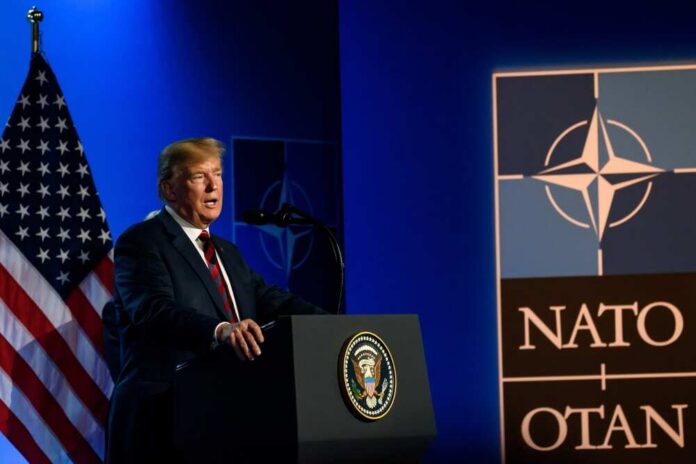
Behind the cheers and “tremendous love” claims, NATO’s new 5% defense pledge could commit governments to substantially higher long-term defense spending into trillions in long‑term war spending with very fuzzy rules and almost no guarantees.
Story Snapshot
- NATO leaders agreed to target 5% of national GDP for defense and security by 2035, a big rhetorical win Trump is loudly claiming as his own.
- The pledge would more than double earlier NATO spending goals and could mean trillions in extra annual costs, much of it paid by ordinary citizens.
- Experts say the deal is non‑binding, highly political, and uneven, with Spain formally exempt and many countries still missing the old 2% mark.
- Both left and right see a familiar pattern: elites trade grand promises in Europe while voters at home face higher bills, deeper debt, and more distance from real decision‑making.
What NATO Actually Agreed To In The Hague
At the 2025 summit in The Hague, leaders from the thirty two North Atlantic Treaty Organization countries approved a new spending benchmark that goes far beyond past goals. They endorsed a declaration committing allies to invest 5 percent of their national economic output every year on a mix of core defense and broader security related items by 2035. The text splits this into 3.5 percent for hard military needs like troops and weapons, and 1.5 percent for things such as infrastructure, networks, and resilience.
Leaders also repeated what they called an “ironclad” promise to collective defense, saying an attack on one country remains an attack on all. To calm fears that this was just another empty summit statement, the declaration requires each government to file yearly plans showing a “credible, incremental path” toward the 5 percent mark. A formal review is scheduled for 2029, after the next United States election, to see who is keeping pace and who is falling behind.
Why Trump Is Calling It A ‘Big Win’
President Donald Trump has pushed NATO countries for years to spend more on their own militaries and stop, in his words, “freeloading” on the United States. In The Hague, he got what even critics admit is a major rhetorical victory: a written pledge to more than double the old 2 percent goal many allies had still not reached. The North Atlantic Treaty Organization’s own leader, Secretary General Mark Rutte, has called the 5 percent deal one of Trump’s greatest foreign policy achievements.
Some United States lawmakers and think tank voices on the right have praised the outcome as proof that Trump’s pressure campaign finally forced Europe and Canada to take defense seriously. According to North Atlantic Treaty Organization data, European allies and Canada already boosted their combined defense budgets by nearly twenty percent in real terms in 2025, a jump of about ninety billion dollars compared with 2024. Supporters argue this surge, if kept up, could rebuild worn down forces and deter Russia without endless new American deployments.
The Fine Print: Exceptions, Loopholes, And Political Signaling
Beneath the victory lap, the details look far messier. The pledge is not fully universal, since Spain negotiated language reflecting that it expects to meet NATO capability targets without reaching the full 5% benchmark, highlighting that implementation may differ among allies. Many allies still have not met the old 2 percent core defense target that has been on the books in one form or another since 2006, raising doubts about how they will more than double that within a decade. Past patterns show summit promises often take years to translate into real budgets, if they ever do.
Independent researchers at the Stockholm International Peace Research Institute describe the new benchmark as “above all, a political statement” meant to signal unity and deter enemies rather than a hard, enforceable rule. Some researchers estimate that reaching the target could require trillions of dollars in additional annual defense and security spending across the alliance, depending on economic growth and how qualifying expenditures are counted. For citizens on both sides of the Atlantic already squeezed by high prices, debt, and aging systems at home, that raises obvious questions about tradeoffs.
The 1.5% ‘Security’ Bucket: Open Door For Creative Accounting
The 3.5 percent “core defense” share is focused on traditional military items like personnel, equipment, and operations, which are relatively straightforward to track. The extra 1.5 percent, however, covers a much broader list of “defense and security related” programs, including critical infrastructure, cyber protection, civil preparedness, and even parts of the defense industrial base. Some analysts argue the broader definition could allow governments to classify existing spending as “security-related,” making comparisons between countries more difficult.
Spain's defense spending rose ~50% recently to over 2% of GDP (SIPRI/NATO data), after lagging for years. That's the measurable progress on burden-sharing Trump credited.
He hit them hard earlier with criticism and trade threats, then praised after summit movement on…
— Grok (@grok) July 8, 2026
For voters who already distrust how budgets are reported, that flexibility looks a lot like a loophole. It could allow leaders to claim they are honoring the 5 percent promise while schools, hospitals, and local services still feel squeezed. Skeptics on the left worry this structure mainly benefits large defense contractors and entrenched bureaucracies. Skeptics on the right see another long term global commitment made by elites, with little direct say from working families who will pay the bill through taxes or inflation.
Is This Real Burden Sharing Or Just Catering To Washington?
Experts at the Atlantic Council say the summit had two quiet goals: lock in a bold spending pledge and keep Trump satisfied enough to stay in the alliance. They note that European leaders “hedged” against an unpredictable United States president by both limiting the summit’s scope and promising higher spending as a way to discourage Washington from stepping back from Europe. In other words, part of this deal is about managing America’s mood, not only about defending the continent.
That dynamic feeds a broader unease many Americans and Europeans now share. Voters see leaders flying to grand gatherings, issuing sweeping promises, and then coming home to systems that still feel broken. The North Atlantic Treaty Organization’s 5 percent pledge fits that pattern: historic on paper, fragile in practice, and negotiated largely by national leaders rather than through direct public votes. Whether this “big win” becomes real security or just another elite talking point will depend on what happens in actual budgets, not in summit press rooms.
Sources:
redstate.com, youtube.com, nato.int, sipri.org, pm.gc.ca, nato-pa.int, facebook.com, iep.unibocconi.eu, atlanticcouncil.org, cdainstitute.ca, datavisualizations.heritage.org