China’s vehement opposition to the largest US arms sale to Taiwan yet underscores escalating military tensions.
Story Highlights
- China condemns $11 billion US arms sale to Taiwan, calling it provocative.
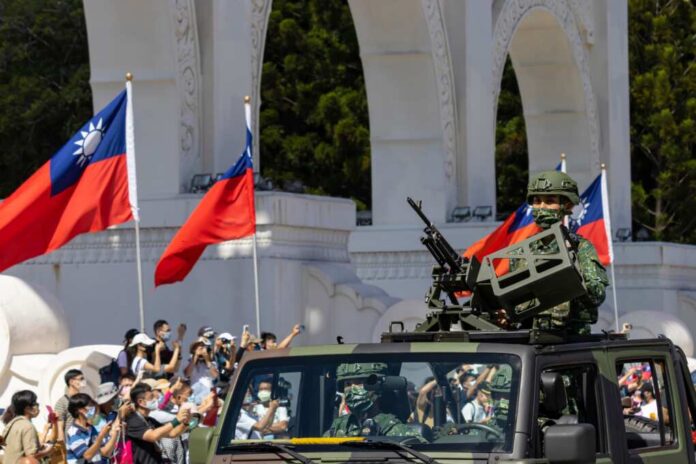
- The People’s Liberation Army (PLA) conducts military drills near Taiwan.
- Chinese Foreign Minister Wang Yi warns of countermeasures against US actions.
- This sale occurs amid strained US-China relations and Taiwan’s defense fortification.
China’s Condemnation of US Arms Sale
On December 18, 2025, the United States announced an unprecedented $11 billion arms package to Taiwan, including advanced military equipment like rocket artillery and long-range missiles. This move provoked a strong reaction from China, where Foreign Minister Wang Yi denounced the sale as a provocative measure threatening regional stability. The announcement coincided with significant military drills conducted by the People’s Liberation Army around Taiwan, amplifying tensions in the region.
Wang Yi emphasized that the arms sale undermines China’s sovereignty and reiterated China’s commitment to reunification with Taiwan, a core interest of Beijing. He stated that China would take necessary countermeasures against both US actions and forces advocating for Taiwan’s independence. The timing of the PLA drills, coinciding with the arms sale, further signals China’s resolve to maintain pressure on Taiwan and its allies.
LFG 🇺🇸🇹🇼 !!!!
The US has just approved a $11.1 billion arms package for Taiwan, the largest in its history.
This sale, including weapons such as drones, rocket systems, anti-tank missiles and software, is mostly geared toward dealing with asymmetric warfare.
The deal marks the… pic.twitter.com/DYaRBH3rJZ
— Melissa Chen (@MsMelChen) December 18, 2025
Historical Context and Strategic Implications
The Taiwan issue traces its roots back to the Chinese Civil War, leading to Taiwan’s de facto independence under US protection. Historical agreements between the US and China, such as the 1978 Joint Communiqué, acknowledged the “one China” policy. However, recent US arms sales have been perceived as violations of these communiqués, leading to increased military posturing by China. The ongoing PLA drills, combined with information operations, aim to erode confidence in Taiwan’s defense capabilities and reinforce Beijing’s stance on reunification.
The scale of the arms package highlights the strategic importance of Taiwan in the broader US-China rivalry. The US’s decision to bolster Taiwan’s defense capabilities aligns with its commitment to the “first island chain” strategy, meant to counter China’s growing military influence in the region. This situation presents a complex challenge for US policy, balancing strategic deterrence with diplomatic tensions.
Potential Ramifications for Global Stability
In the short term, the arms sale and subsequent Chinese military drills increase the risk of escalations in the Taiwan Strait. This tension could lead to further Chinese sanctions on US firms involved in the arms sale and amplify psychological strain on Taiwan’s populace. In the long term, the situation accelerates the US-China arms race, testing existing diplomatic agreements and potentially shifting towards “coercion short of war,” such as cyberattacks or limited strikes.
The economic, social, and political impacts are far-reaching. Economically, US defense contractors may face disruptions, while broader trade relations could suffer. Politically, this reinforces alliances among the US, Taiwan, and Japan against China’s partnerships. Socially, it fuels nationalism within China and anxiety in Taiwan, complicating the geopolitical landscape further.
Sources:
China condemns US arms sales to Taiwan
Top Chinese diplomat rips record US arms sale
China drills feed info war targeting faith in Taiwan’s defenses