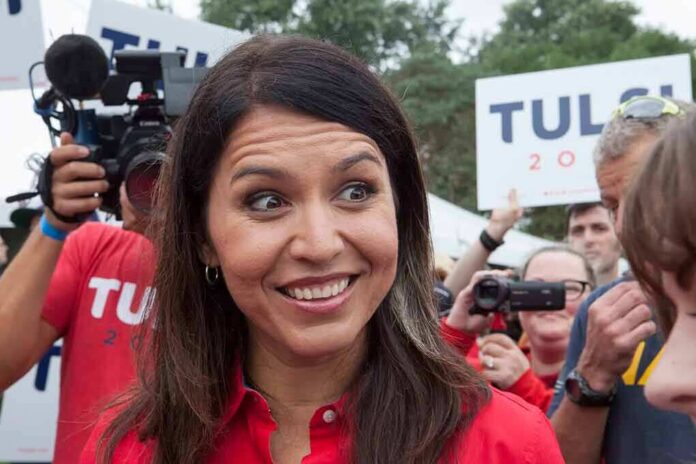
When the nation’s top spy suddenly steps down in the middle of global crises, and all we get are a few polished talking points, it reinforces the feeling that Washington tells the public only what it thinks we can handle.
Story Snapshot
- Tulsi Gabbard resigned as director of national intelligence, citing her husband’s cancer diagnosis and setting June 30 as her last day.[3][4][5]
- President Trump publicly backed her explanation and praised her performance while naming deputy Aaron Lukas as acting director.[4][5]
- News coverage links her exit to months of tension over Iran policy and internal Trump administration power struggles.[3][5]
- Lack of primary documents about her resignation fuels bipartisan suspicion that the public is not getting the full story about a critical national‑security post.[3][4]
A Sudden Exit From America’s Top Intelligence Job
Director of National Intelligence Tulsi Gabbard announced Friday that she is resigning from President Trump’s Cabinet, telling the country she needs to step away to help her husband battle a rare form of bone cancer.[3] Her resignation is scheduled to take effect June 30, giving the administration several weeks to manage the transition.[3][4][5] Multiple outlets report that she shared a resignation letter on social media, framing the move as a personal decision rooted in family health needs.[3][5]
President Trump publicly echoed Gabbard’s explanation, posting that her “wonderful husband” had recently been diagnosed and that she “rightfully” wants to be by his side.[5] He praised her work as director of national intelligence and said she would be missed.[5] The Office of the Director of National Intelligence leadership page and broadcast reports indicate that her current principal deputy, Aaron Lukas, will take over as acting director after June 30, ensuring continuity atop the sprawling intelligence bureaucracy.[4][5]
Personal Reasons, Policy Fights, And A Familiar Washington Pattern
Television coverage and online summaries repeatedly state that Gabbard’s departure is rooted in her husband’s cancer diagnosis, reinforcing a tightly coordinated personal narrative.[3][5] At the same time, those same reports remind viewers that her tenure has been marked by serious internal disagreements, particularly over Iran.[3] After the June 2025 “Midnight Hammer” operation, she reportedly told the Senate Intelligence Committee that Iran’s enrichment capacity was “obliterated,” undercutting administration claims of an ongoing imminent nuclear threat.[3]
Commentators now place her resignation inside a broader struggle between competing foreign‑policy factions in Trump’s second term.[3] Analysts describe Gabbard as part of a more skeptical, anti‑war wing that had clashed with more hawkish advisers over how far to push confrontation with Iran and other adversaries.[3] Reports also say Trump had privately asked advisers about replacing her months before this announcement, suggesting personnel changes were already under discussion inside the West Wing. None of those political tensions, however, appear in the limited public explanation released so far.[3][5]
Why This Fuels Deep Distrust On Both Right And Left
The combination of a highly scripted personal explanation and visible political context feeds the sense, across the spectrum, that Washington is once again managing the public rather than leveling with it.[3][4] Conservatives who already distrust the intelligence establishment as part of a permanent “deep state” see another high‑profile shake‑up with no real transparency about who is driving policy behind closed doors.[4] Many remember years of secrecy around surveillance, foreign wars, and election‑year investigations that never seem fully explained.
Progressives, meanwhile, watch an official who challenged hawkish narratives about Iran exit quietly, with no documentation that her dissent had any role in the decision.[2][3] Members of the Congressional Black Caucus and allied activists had previously demanded her resignation for what they called dangerous mismanagement, presenting a completely different critique of the same official.[2] Whether one thinks Gabbard was too cautious or too aggressive, it is hard to ignore how quickly competing stories about her performance are being buried beneath a single, sanitized public line.[2][3]
Limited Evidence, Big Stakes, And What Comes Next
From the documents and reporting publicly visible so far, there is solid confirmation that Gabbard is leaving, that June 30 is the target date, and that she and President Trump both cite her husband’s cancer as the stated reason.[3][4][5] There is also a well‑documented record of policy clashes and political pressure surrounding her tenure.[2][3] What is missing are the primary records that could connect—or separate—those two realities: the full resignation letter, internal personnel memos, and any contemporaneous notes about why this change happened now.
US intelligence chief Tulsi Gabbard announced her resignation
Aaron Lukas named acting director of National Intelligence@Rhythmsharmax has more pic.twitter.com/5woZjObnfQ
— WION (@WIONews) May 23, 2026
Health privacy and executive‑branch secrecy mean the public may never see that evidence unless Congress or investigative reporters dig it out.[3][4] For citizens already convinced that an unaccountable elite runs Washington for its own benefit, another opaque departure at the top of the intelligence apparatus looks like more of the same.[3][4] As Aaron Lukas steps in as acting director, Americans on the right and left will be watching less what officials say about this transition and more whether U.S. intelligence policy becomes more transparent—or even more insulated from public scrutiny.
Sources:
[2] Web – Kamlager-Dove Leads Members of the CBC in Calling for DNI Tulsi …
[3] YouTube – BREAKING: Tulsi Gabbard resigns as director of national intelligence
[4] Web – Director of National Intelligence – ODNI
[5] YouTube – What we know about acting director of national intelligence