Tyler Robinson’s own text messages — shown in open court — may be the most damaging evidence yet in the killing of conservative activist Charlie Kirk.
Story Snapshot
- Robinson’s roommate and romantic partner, Lance Twiggs, testified that Robinson confessed to the shooting in text messages, saying “I am, I’m sorry.”
- Texts also directed Twiggs to find a handwritten note under a keyboard that read Robinson planned to “take out Kirk” when he got the chance.
- Surveillance footage introduced by prosecutors appears to place Robinson on the roof shortly before the gunshot.
- Defense attorneys are fighting back, pointing to missing shell casings at the scene and challenging whether key interview testimony can be used at trial.
Roommate Takes the Stand With Texts in Hand
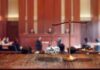
Lance Twiggs, Robinson’s roommate and former romantic partner, testified on July 9, 2026, during the final days of Robinson’s preliminary hearing. Twiggs told the court that after the shooting, he texted Robinson directly and asked if he was the shooter. Twiggs testified that prosecutors introduced text messages in which Robinson allegedly replied, “I am, I’m sorry.” Twiggs testified he found a handwritten note beneath the keyboard before photographing it..
A 37-minute recorded interview between Twiggs and a prosecutor was played in court. In it, Twiggs said Robinson told him he “wishes he hadn’t done it” and that he would either talk to his parents or turn himself in. Robinson also texted that he still needed to “grab my rifle” and had hoped to “keep this secret till I died of old age.” Prosecutors say these messages show clear planning and intent — not a spontaneous act.
Video Places Robinson on the Roof at the Right Time
Surveillance footage shown in court tracked Robinson across the Utah Valley University campus on the morning of the shooting. Video shows him near the amphitheater around 9:25 a.m., returning to his vehicle, then reappearing after 10 a.m. carrying a blue backpack. He was then seen on the roof of the Losee building, crouching near the southwest corner just before 12:23 p.m. The gunshot was recorded at 12:23:28 p.m.
After the shot, footage shows Robinson jumping off the roof carrying an unidentified object. Prosecutors argued the limp was consistent with jumping from the roof, while other explanations remain possible. That same evening, when Robinson surrendered to police, he was wearing a maroon T-shirt that matched what the person on the roof had been wearing earlier that day.
Defense Pokes Holes — But Core Evidence Stands
The defense has raised real questions. Most striking: Officer Bagley testified that no shell casings or unspent bullets were found on the Losee rooftop, which is unusual for a rifle that normally ejects casings automatically. Defense attorney Nicole Deour also argued that parts of Twiggs’ recorded interview may include leading questions, which could make some of that testimony inadmissible at trial. Even Deour acknowledged, however, that the state likely met the lower standard needed for probable cause at this stage.
🚨 SHOCKING COURTROOM BOMBSHELL:
Tyler Robinson's demeanor SHATTERS live in court as his FORMER LOVER'S testimony is played for the world!
In the ongoing preliminary hearing for the assassination of Charlie Kirk, prosecutors dropped a devastating recorded interview with Lance… pic.twitter.com/dW3K1iCJTP
— Dr. Dawn Michael (@DawnsMission) July 10, 2026
The defense also challenged Federal Bureau of Investigation (FBI) DNA analyst Amanda Bakker’s findings, with attorney Michael Burt arguing the testing method used cannot definitively match Robinson to samples found on the rifle. At this stage of the hearing, the defense focused primarily on the physical evidence and forensic testimony rather than directly contesting the text messages themselves. The handwritten note Twiggs photographed has not been recovered, adding uncertainty but not disproving its existence. This case now heads toward trial with strong digital evidence, contested physical evidence, and a divided public watching closely.
Sources:
pjmedia.com, nypost.com, youtube.com, bbc.com, kutv.com